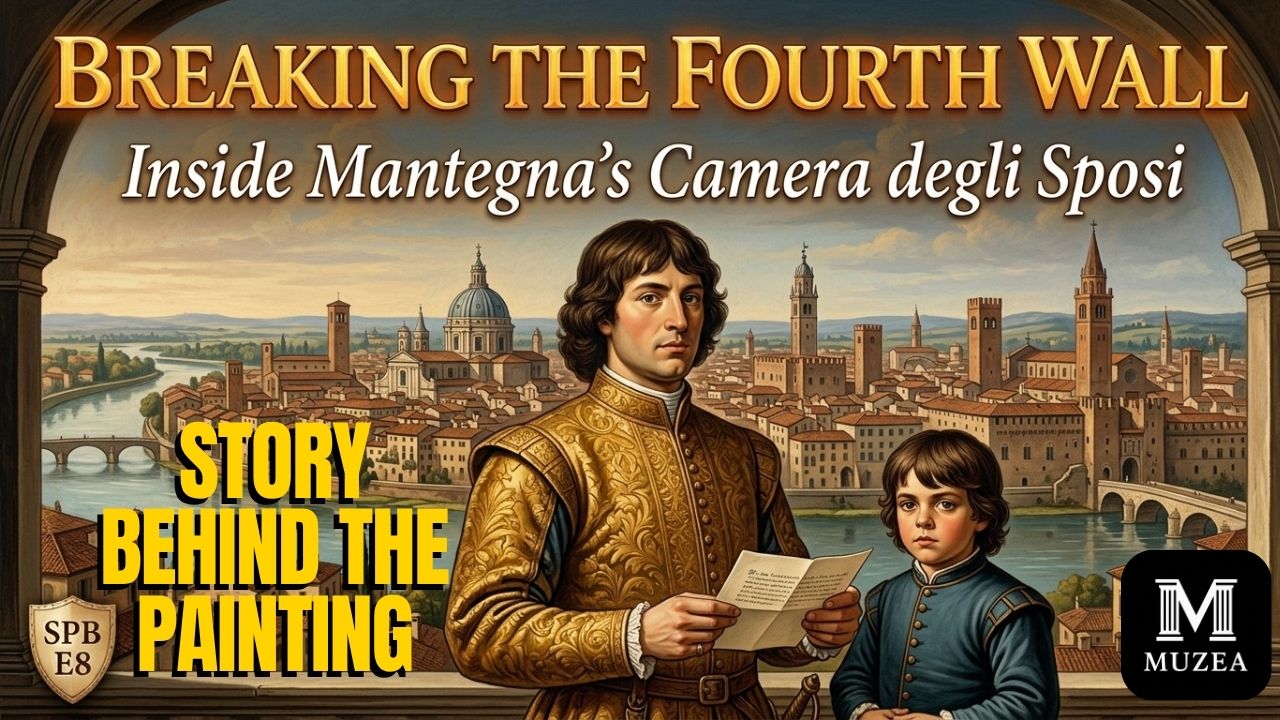
In the grand tapestry of the Italian Renaissance, few rooms hold as much mystery, power, and technical wizardry as the Camera degli Sposi (Room of the Newlyweds) in Mantua’s Palazzo Ducale. Completed in 1474 by the master Andrea Mantegna, this space isn’t just a decorated room—it is a nine-year labor of love that fundamentally changed the trajectory of Western art.
The latest episode of Story Behind the Painting by MUZEA takes us inside this “painted cube,” revealing the secrets of the Gonzaga family and the man who learned to “carve” with a paintbrush.
A Room of Paradoxes
Located in the northeast tower of the Castel San Giorgio, the Camera degli Sposi (also known as the Camera Picta or “Painted Room”) is a near-perfect cube, measuring roughly 8.1 meters on each side [02:34].
While the room’s name suggests a private bridal chamber, its function was far more public. It served as a high-stakes reception space where Ludovico III Gonzaga, the Marquis of Mantua, met with ambassadors and rivals. In a world where Mantua was a “small, swampy Marquisite” lacking the banking power of Florence or the agricultural vastness of the South, Ludovico used this room as a form of “soft power” [08:42]. By commissioning the most technologically advanced room in Europe, he signaled that he was a man of supreme intellect and Roman-style authority [09:10].
The Snapshot of Power: The Court Scene
On the north wall, Mantegna captures the Gonzaga family not in a stiff, formal pose, but in a living “snapshot.” Ludovico is seated, turning toward his secretary who whispers a message or hands him a letter [05:38].
History suggests this letter might have been the moment Ludovico learned his ally, the Duke of Milan, was dying—a political earthquake that could secure his legacy or spark a war [05:46]. Beside him sits his wife, the stoic Barbara of Brandenburg, surrounded by their children. Even the family dog, Rubino, is present under Ludovico’s chair, symbolizing the loyalty required in a world of shifting political shadows [06:07].
The Witness in the Corner
One of the most striking figures in the fresco is the court dwarf, standing beside Barbara of Brandenburg [00:16]. Often overlooked, she represents a position of strange, paradoxical status in the 15th century. Her expression, sometimes described as “grumpy,” is interpreted by MUZEA as the “heavy, watchful gaze” of someone who has seen every secret and every hushed deal of one of Italy’s most powerful dynasties [00:44].
Mantegna: The Amateur Archaeologist
To understand the art, you must understand the artist. Andrea Mantegna was obsessed with Roman antiquity [10:11]. Unlike the soft, ethereal figures of his Florentine contemporaries, Mantegna’s subjects look as if they were carved from stone. This “sculptor’s brush” style came from years of studying broken Roman statues and ancient coins [10:20].
He was also a “scientist of materials.” While the ceiling is a true fresco (painted into wet plaster), Mantegna used a mixed-media approach for the walls. To achieve the jewel-like colors of the Gonzaga’s silk and the intricate details of their faces, he painted a secco (on dry plaster) using walnut oil and tempera [03:38]. This high-definition detail came at a cost: it was incredibly slow, taking nine years to complete, and made the work fragile, requiring the climate-controlled environment we see today [04:08].
The Miracle of the Oculus
The crowning achievement of the room—literally—is the ceiling. At its center is the famous Oculus, a circular window to a faux-sky [03:05].
Here, Mantegna pioneered the technique of di sotto in sù (from below upward) [11:11]. He realized that if a viewer is standing on the floor looking up, the figures must be “foreshortened” to look compressed and realistic. The result is breathtaking: cherubs (putti) lean over a balcony, a lady looks directly down at us, and a large potted plant teeters on the edge as if it might fall [11:28].
This wasn’t just a painting; it was the birth of illusionism. Mantegna viewed the walls and ceiling not as flat surfaces, but as obstacles to be removed [10:59]. He made the viewer feel as if the room had literally opened up to the heavens.
A Legacy of Illusion
By the time Mantegna finished in 1474, he had proven that a painter could be a director, an architect, and a magician all at once [12:07]. His techniques paved the way for giants like Leonardo da Vinci and his own brother-in-law, Giovanni Bellini.
When you step into the Camera degli Sposi, you aren’t just looking at 15th-century politics; you are witnessing the moment art learned to break the fourth wall and invite the viewer into the story.
Watch the full episode for a deep dive into the visuals: