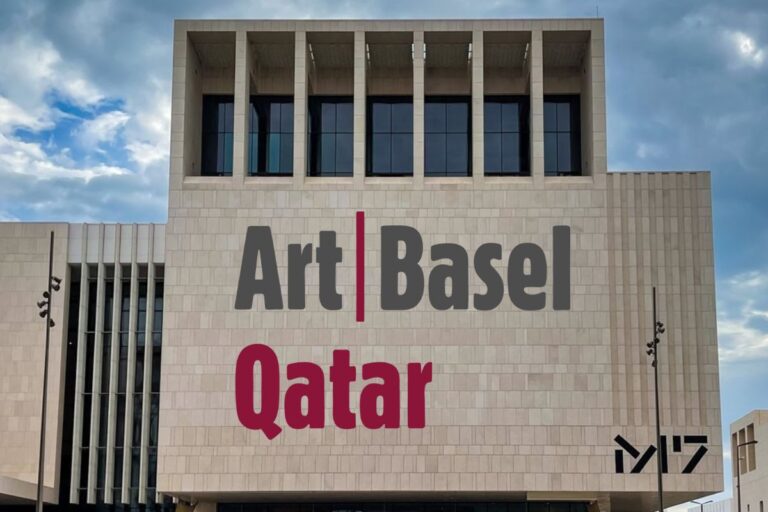
Art Basel Qatar represents a departure from the “copy-paste” model of international art fairs. Rather than a sprawling marketplace, the Doha edition feels edited and considered—a rhythm more akin to a museum exhibition than a traditional trade event.
The Power of the Solo-Presentation Model
The most significant structural shift in Doha is the move away from multi-artist booth logic. By prioritizing presentations built around a single artist, the fair fundamentally alters the viewer’s engagement.
Instead of scanning a compressed inventory of “greatest hits,” visitors are invited to step into a singular artistic position. This shift forces a psychological deceleration; the fair design encourages visitors to slow down and engage with the depth of a specific practice rather than the breadth of a gallery’s stock.
Intentional Concentration vs. Global Scale
While Art Basel’s iterations in Miami Beach, Paris, or Hong Kong are defined by their overwhelming scale and high-decibel visual noise, Doha is intentionally concentrated. Despite its physical footprint within the Doha Design District, the fair can appear smaller than its reality because it is curated for legibility. It favors a “less but better” approach that prioritizes the clarity of the work over the volume of the participants.
Verticality: A Three-Tiered Architecture
The spatial logic of the M7 venue creates a vertical narrative that breaks the monotony of the “endless hall” experience. The fair is distributed across three distinct levels:
-
Area 1 (Ground Level): Serving as the gravitational entry point and high-energy core.
-
Area 2 (First Floor): A transition zone designed for a calmer, more breathable experience.
-
Area 3 (Second Floor): A space where the fair opens up again, offering the highest level of visual legibility.
While this vertical structure is designed to disperse the crowd, the initial preview demonstrated the challenges of this layout. The ground level naturally becomes a high-intensity pressure point, particularly when high-profile attendance—such as the presence of the Emir of Qatar—necessitates heightened security and draws concentrated attention. These moments of congestion create a brief contradiction between a fair designed for “slow looking” and the logistical realities of a major state-supported event.
The Strategic Value for Collectors
The “editorial” nature of Art Basel Qatar offers a distinct advantage for serious collectors. By treating each booth as a single argument, the fair provides:
-
Narrative Clarity: Presentations read as cohesive chapters rather than a rack of disparate names.
-
Artistic Depth: Collectors can sense an artist’s internal logic, moving beyond the “hero work” to understand the full practice.
-
Intellectual Longevity: The fair prioritizes long-term memory of specific artistic positions over temporary market heat.
Global Gravity vs. Regional Resonance
The exhibitor mix at Art Basel Qatar functions as a strategic bridge. It balances the institutional weight of global blue-chip galleries with a serious commitment to regional representation—an essential signal in a landscape where the primary question is not just what arrives from abroad, but which local and regional voices are being amplified.
A selective snapshot of the fair’s most notable gallery-artist pairings illustrates this curated approach:
-
Gagosian: A focused look at Christo’s early sculptural works from the late 1950s, highlighting themes of containment and displacement.
-
Hauser & Wirth: An intimate survey of Philip Guston, tracing his transition from abstraction to his influential late-period figuration.
-
David Zwirner: A powerful presentation of Marlene Dumas, whose work explores the complexities of identity and conflict.
-
White Cube: Large-scale works by Georg Baselitz, anchoring the fair’s European expressionist presence.
-
Pace Gallery: The fluid, organic bronze and polyurethane forms of Lynda Benglis.
-
Galerie Chantal Crousel: A rigorous presentation of Mona Hatoum, utilizing domestic materials to explore global themes of constraint.
-
October Gallery: The masterful, draped metal tapestries of El Anatsui.
-
The Third Line: A homecoming presentation for Sophia Al-Maria, whose “HiLux” installation reclaims Gulf Futurism through the lens of Bedouin car culture.
-
Tabari Artspace: A deep dive into Hazem Harb’s explorations of Palestinian architecture and memory.
-
Athr Gallery: Ahmed Mater’s “Temporal Migration,” a photographic survey documenting the shifting urban and social landscape of Makkah.
-
al markhiya gallery: New works by Qatari artist Bouthayna Al Muftah, whose practice translates local heritage into contemporary visual language.
The Memory of the Singular
Even within a brief visit, the fair’s ultimate strength becomes obvious: it is structured to be remembered through singular artistic encounters, not through accumulation. By rejecting the traditional multi-artist booth in favor of authored, editorial positions, Art Basel Qatar ensures that what lingers is not the noise of the market, but the clarity of the work itself.