Author

MUZEA

Browsing

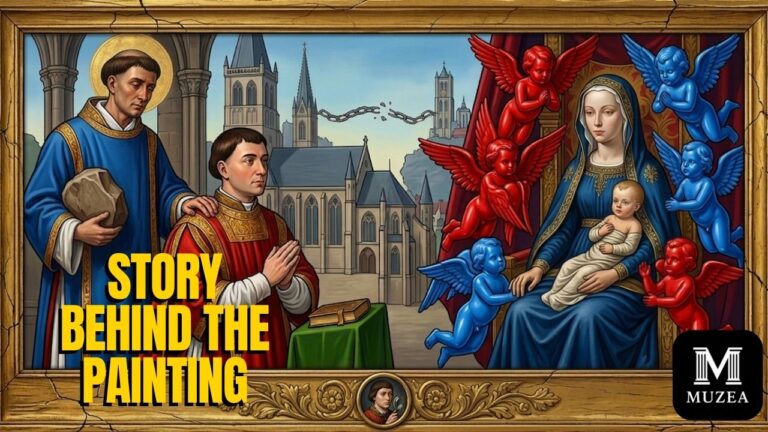
If you stumbled across the right panel of the Melun Diptych without context, you might assume it was a modern CGI render, a surrealist fever dream from the 1920s, or perhaps a high-fashion editorial. The Virgin Mary is startlingly pale, her hairline is plucked back to another zip code, and she sports a perfectly spherical, exposed breast.

But this isn’t modern art. It was painted in 1452 by Jean Fouquet, and it remains one of the most provocative, unhinged, and “messy” devotional paintings in history.


The Power Player: Etienne Chevalier

To understand this painting, we first have to meet the man who paid for it: Etienne Chevalier. In the 1450s, Etienne was the “CFO of France”—the royal treasurer for King Charles VII. A self-made man who rose through the ranks, he was described as incorruptible, trustworthy, and so close to the king that he was the executor of the royal will [03:00].

Etienne commissioned this diptych to hang over his wife’s tomb in the Church of Notre-Dame in Melun. In the left panel, we see Etienne himself in a permanent state of prayer. Standing behind him is his namesake, St. Stephen (Etienne in French).

St. Stephen is dressed as a deacon in stunning blue robes, but he’s carrying a gruesome “signature accessory”: a jagged, bloodstained stone resting on a book [03:25]. As the first Christian martyr, Stephen was stoned to death, and in medieval art, saints always carry the instruments of their demise like a grim fashion statement.

The Scandalous Madonna: Agnès Sorel

The right panel is where things get “spicy.” While the diptych was meant to honor Etienne’s late wife, the Virgin Mary looks nothing like her.

Art historians have long held an “open secret”: the model for the Virgin is believed to be Agnès Sorel, the “Lady of Beauty” and the official mistress of King Charles VII [04:13]. Etienne wasn’t just the king’s treasurer; he was one of Agnès’s closest friends.

By commissioning a painting where the king’s mistress is depicted as the Mother of God, Etienne was pulling off the ultimate 15th-century “flex.” He was signaling his proximity to power, his grief for a lost friend, and his hope for a VIP pass to heaven by knowing the right people. It’s a bizarre mix of humble devotion and high-society blasphemy [05:01].

The Artist from the Future: Jean Fouquet

If the Melun Diptych feels like it’s from another dimension, it’s because Jean Fouquet was an artist ahead of his time. Around 1446, Fouquet did a “study abroad” trip to Italy [05:37]. He was one of the few French painters of his era to study Italian linear perspective and 3D volume, even painting a portrait of Pope Eugenius IV while in Rome.

Fouquet was also a master miniaturist, accustomed to looking at the world through a magnifying glass. He used a technique involving melted glass (enamel) to give his work a high-gloss, high-definition finish that looks like a 4K screen [06:14].

The result is the Uncanny Valley. Look at the angels surrounding Mary: they aren’t soft or fluffy. They are monochromatic, bright red cherubim and blue seraphim that look like polished plastic figurines [07:08]. Fouquet used geometry and lighting in a robotic, supernatural way to create a high-fashion atmosphere that felt more like a “liminal space” than a traditional church.

A Long-Distance Tragedy

Today, the Melun Diptych is a victim of a “historical divorce.” During the French Revolution, the two halves were ripped apart. The left panel (the “boys”) now lives in Berlin, while the right panel (the “queen”) lives in Antwerp [07:48].

Scientists used dendrochronology (tree-ring dating) to prove the two panels are “soulmates”—both were cut from the exact same oak tree felled in 1446 [07:59]. Though they belong together, they haven’t shared a room in centuries.

The World’s First Selfie

Fouquet knew he was the “GOAT” (Greatest of All Time). He didn’t just paint the diptych; he signed it with a tiny enamel medallion of himself [08:18]. This is considered the oldest signed self-portrait in Western art history. He wanted the world to remember the name: Johes Fouquet.

The Melun Diptych serves as a reminder that people in the 1400s were just as obsessed with status, celebrity, and “aesthetic” as we are today. Next time you think your social media feed is too curated, just remember that Etienne Chevalier spent his life savings to be remembered forever standing next to the king’s mistress in a blue-and-red fever dream.


Stay curious. Stay messy.

Watch the full episode on MUZEA:
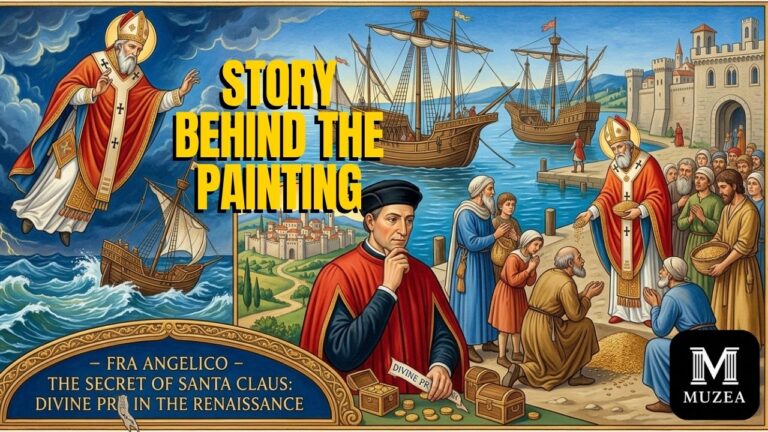
When we think of St. Nicholas today, the image that usually springs to mind is a jolly, white-bearded man in a red suit delivering toys in the dead of winter. But in the 15th century, “Santa Claus” looked quite different. He was a powerful, miracle-working fixer, a patron of merchants, and a spiritual “crisis manager.”

In the latest episode of Story Behind the Painting, we explore Fra Angelico’s 1437 masterpiece, St. Nicholas Saves the Ship. This work doesn’t just show us a saint; it reveals the complex intersection of faith, finance, and early Renaissance “influencer culture.”


From Bishop of Myra to Global Icon

Before he was a pop-culture legend, St. Nicholas was a 4th-century bishop in Myra (modern-day Turkey) [02:03]. While the “Golden Legend”—the medieval collection of saintly lives—is full of embellishments, the historical core of Nicholas is real.

The gift-giving tradition we associate with Christmas began with a story of Nicholas secretly providing bags of gold to a poor man to save his daughters from a life of destitution [02:35]. As the episode explains, this figure eventually evolved into Sinterklaas in the Netherlands and was brought to the New World by Dutch settlers, eventually merging into the modern Santa Claus we know today [02:42].

The Miracle of the Grain Ship

Fra Angelico’s painting, commissioned as a predella panel for an altarpiece in Perugia, depicts a different side of the saint [03:37]. Instead of toys, Nicholas is dealing with a grain ship during a famine.

The painting uses a technique called continuous narrative [03:53]. In a single frame, we see multiple moments of time:

  • A dramatic storm where the saint intervenes to save the vessel.

  • The calm harbor where the grain is safely distributed to a starving population.

By merging these moments, Fra Angelico highlights Nicholas’s role as a protector of the vulnerable—specifically sailors, merchants, and bankers who faced the treacherous risks of the 15th-century economy [01:22].

The “Selfie” of the 1400s: Cosimo de’ Medici

Perhaps the most intriguing detail in the painting is the presence of a figure in a prominent red cloak and black cap. Art historians believe this is none other than Cosimo de’ Medici, the de facto ruler of Florence and the head of the most powerful bank in Europe [04:40].

Why is a billionaire banker standing in a scene from the 4th century?

The episode draws a sharp modern parallel: it’s like a modern-day influencer filming themselves giving money to the poor to boost their image [05:02]. This was “Divine PR.” By placing himself next to St. Nicholas, Cosimo was linking his family’s immense wealth to divine favor. It served as a public statement to legitimize his financial practices and signal his piety to the masses [05:11].

A Touch of the Surreal

While Fra Angelico is known for his luminous colors and profound spirituality, the episode notes that this painting has a surprisingly “surreal” quality [06:11]. Because it presents multiple timelines and scales in one space—with realistic ships alongside a fantastical sea monster and an ethereal hovering saint—it evokes a dreamlike quality that predates the surrealist movement by centuries [06:20].

Fra Angelico was a Dominican friar who bridged the gap between the late Gothic style and the emerging Renaissance [05:51]. In this panel, he managed to capture both the mystical power of faith and the very grounded, political realities of his patrons.

Conclusion

St. Nicholas’s journey from a Turkish bishop to a Dutch folk hero to a global commercial icon is one of history’s most fascinating cultural evolutions. Fra Angelico’s St. Nicholas Saves the Ship reminds us that before the reindeer and the chimney, he was the saint you called when your ship was sinking—literally and financially.


Want to dive deeper into the world of art? Download the MUZEA app on the App Store or Google Play to explore more stories behind the world’s most famous paintings.

Watch the full episode here:

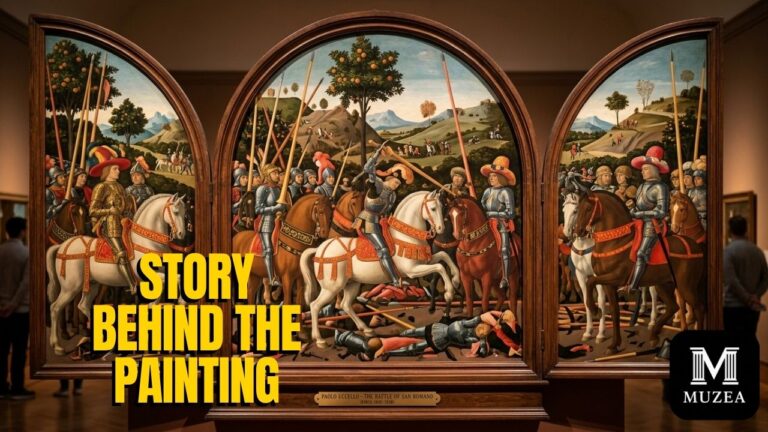
Imagine a 15th-century masterpiece that feels less like a static image and more like an action movie—horses rearing, lances breaking, and soldiers thrown backward in mid-air. Welcome to the world of Paolo Uccello’s The Battle of San Romano.

In the fourth episode of Story Behind the Painting, we explore how a relatively small skirmish in 1432 between Florence and Lucca became one of the most famous examples of propaganda, mathematics, and “ceremonial war” in the history of the Italian Renaissance.


A Triptych Divided Across Europe

Today, the Battle of San Romano is a massive work composed of three separate panels. Interestingly, you have to travel across Europe to see the full story:

  • The Dawn (The London Panel): Housed in the National Gallery, London [07:07].

  • The Heat of Battle (The Florence Panel): Located in the Galleria degli Uffizi, Florence [09:29].

  • The Counterattack (The Paris Panel): Found in the Musée du Louvre, Paris [10:41].

500 years ago, however, these panels hung together in the Medici Palace. In fact, Lorenzo de’ Medici loved the paintings so much that he “forcibly moved” them from the Bartolini family villa to his own palace to use them as a ultimate power “flex” [01:51].


The Business of “Bloodless” War

To understand this painting, you have to understand 15th-century Italy. It wasn’t a unified country but a patchwork of wealthy kingdoms that hired private mercenary armies known as Condottieri [04:12].

War was a business, and these “War CEOs” were expensive assets. As a result, battles were often surprisingly bloodless. Mercenaries avoided killing each other because a dead opponent meant the war (and the paycheck) ended [06:04]. Machiavelli famously mocked these conflicts, saying they began without fear and ended without losses [05:48]. Uccello’s painting reflects this: the scene is clean, filled with gold leaf and bright colors, and remarkably free of blood [05:23].

Act I: The Dawn of the Red Hat

The London panel introduces our protagonist, Niccolò da Tolentino [07:17]. You can’t miss him—he’s wearing a massive, bright red and gold velvet hat called a mazzocchio.

While completely impractical for a real fight, the hat serves as a mythological “flex.” It shows Niccolò not just as a soldier, but as an emblematic, visionary leader. In the background, you can see two knights riding away from the center of the fray; they are messengers sent to notify allies that Niccolò is being outnumbered and needs a counterattack [09:12].

Act II: The Unseating of the Enemy

In the Florence panel, we see the turning point of the battle. The Sienese commander, Bernardino della Carda, is literally being unseated from his horse by a Florentine lance [09:37]. Uccello uses this panel to “stack” the scene, showing Florentine soldiers beginning to surround the enemy behind hills and in the distance.

Act III: The Arrival of the Cavalry

The final act in Paris shows the decisive counterattack led by Micheletto Attendolo [10:49]. Having received the message from the first panel, Micheletto arrives just in time to hit the Sienese flank. Once he arrived, the “math” of the battle changed, and the Sienese forces accepted defeat [11:39].


A Revolution in Mathematics: The Persistence of Perspective

While the battle was about propaganda, the execution of the painting was about a revolution in mathematics. Paolo Uccello was obsessed with linear perspective [00:43].

In the London panel, look at the broken lances on the ground. They aren’t scattered randomly; they are meticulously aligned to point toward a vanishing point, creating a radical sense of depth and three-dimensionality [12:05].

Uccello was also a master of foreshortening—painting objects (like the fallen soldier in the bottom left) at an angle to show depth [13:53]. To Uccello, battle was a mess, but geometry was order. By applying these strict rules, he turned a chaotic skirmish into an aesthetically pleasing, eternal stage.

The Medici Mark

When the paintings were moved to the Medici Palace, they had to be altered to fit the walls. The tops were cut, and the Medici added their own family symbol to the landscape: oranges [14:33]. In the 15th century, owning fresh oranges was the equivalent of owning a supercar today—a final, fruity layer of propaganda on an already legendary work.


Watch the full analysis here:

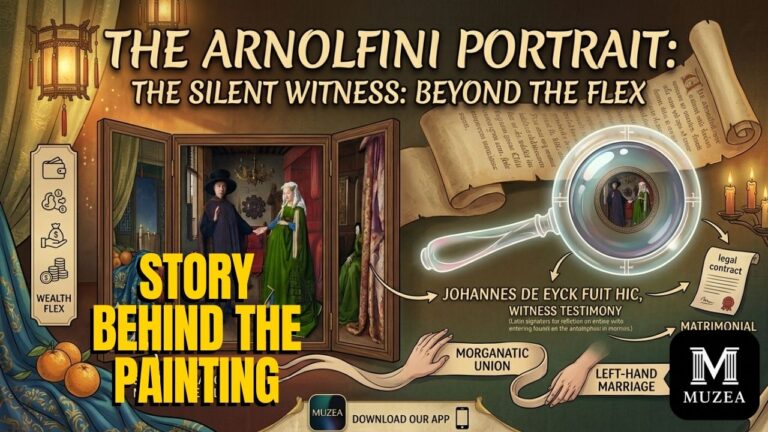
In the mid-15th century, the city of Bruges was the commercial beating heart of Northern Europe. It was a place where Russian furs, Venetian silks, and Spanish oranges collided in a vibrant display of global trade. In this world of rising merchant power, few objects capture the era’s opulence and mystery quite like Jan van Eyck’s 1434 masterpiece, The Arnolfini Portrait (also known as The Arnolfini Marriage).

In the third episode of Story Behind the Painting, we peel back the layers of this iconic oil painting to discover that what looks like a simple wedding portrait is actually a complex legal document, a high-stakes “flex” of wealth, and a masterpiece of Northern Renaissance detail.


The Best of the Best: A Statement of Power

To understand the weight of this painting, one must first look at the artist. Jan van Eyck was the court painter for the Valois dukes of Burgundy—the highest tier of artistic prestige at the time. For the merchant Giovanni di Nicolao Arnolfini and his wife to hire him was a massive statement [03:33]. It was the 15th-century equivalent of a tech CEO hiring a celebrity photographer usually reserved for royalty.

While the Italian Renaissance focused on human physiology and muscles, the Northern Renaissance, led by competitors like Robert Campin and Jan van Eyck, was obsessed with the context and surroundings [02:40]. Every object in the room was placed there with intent.


Subtle Flexing: Oranges, Fur, and Blue Silk

The Arnolfini couple didn’t just want to show they were rich; they wanted to show they were connected.

  • The Blue Textile: The bride’s gown features a vibrant blue, a color that was incredibly expensive and often reserved for royalty [05:22].

  • The Oranges: On the windowsill and chest sit fresh oranges. In 1434 Bruges, these were exotic luxuries imported from Spain or Portugal, costing a fortune to keep fresh [05:29].

  • Excessive Fabric: The bride’s gown is heavy with swathes of extra material. This wasn’t just fashion; it was a sign that they could afford not only the cloth but the servants required to carry and maintain such a cumbersome garment [07:16].

  • The Fur: Both garments are trimmed with expensive furs like mink and sable. Giovanni’s robe is cut to calf-length, signaling he is a “man of action” who needs to move freely for his business [08:44].


The Mystery of the Left Hand: A “Morganatic” Marriage?

One of the most debated details is the way the couple holds hands. Giovanni is offering his left hand, not his right [12:33].

This suggests a “Morganatic marriage” or a “left-hand marriage.” In 15th-century society, this usually occurred when a man of high status married a woman from a lower social class. This type of union came with two strict conditions for the bride [15:55]:

  1. She and her future children relinquished all inheritance rights to the husband’s noble estate.

  2. Her children would not continue the noble family lineage.

In exchange, she was guaranteed financial security if she became a widow. This painting, therefore, likely served as a visual matrimonial contract, documenting the terms of their union in an age before formal church marriage certificates were mandatory [15:12].


The Convex Mirror: A Window to the Artist

At the center of the painting hangs a curved, convex mirror—a technological marvel of the time. Producing a flat mirror was nearly impossible; instead, glassblowers would blow a sphere, coat the inside with mercury and tin, and then cut out a circular section [11:12].

If you look closely at the mirror’s frame, it is decorated with ten tiny medallions depicting the Passion of Christ [11:47]. But even more striking is the reflection itself. In the mirror, you can see two figures entering the room. Above the mirror, Van Eyck wrote in elaborate Latin script: “Johannes de Eyck fuit hic”Jan van Eyck was here [12:14].

This wasn’t just a signature; it was a legal testimony. He was acting as a witness to the marriage contract, a role that would later inspire other great painters like Velázquez in his work Las Meninas [18:22].


Symbols of the Soul

Beyond the wealth and law, the painting is filled with spiritual and domestic symbols:

  • The Dog: A small Brussels Griffon sits at the couple’s feet, symbolizing fidelity and a nurturing home environment [09:46].

  • The Shoes: Removed and placed to the side, the discarded clogs suggest that the couple is standing on “holy ground,” as marriage was considered a sacred sacrament [09:06].

  • The Single Candle: One lit candle in the chandelier during the daytime is often interpreted as the all-seeing eye of God or the presence of the Holy Spirit witnessing the union.

Conclusion

The Arnolfini Portrait is a testament to the power of the Northern Renaissance. It shows a world where art was used as a tool for social positioning, legal protection, and religious devotion. Today, it hangs in the National Gallery in London, continuing to fascinate viewers with its “inception-like” details and the silent testimony of a painter who was “there” nearly 600 years ago.


Watch the full episode here:

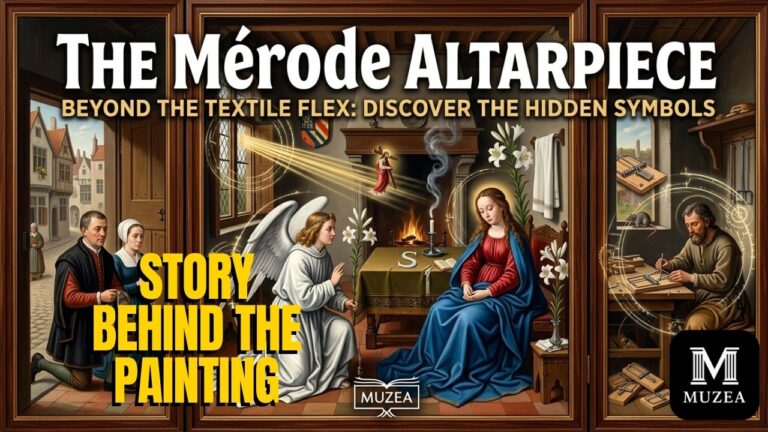
In the modern world, we “flex” our success through designer clothes, high-end smartphones, or luxury travel. In the 15th century, however, the ultimate status symbol wasn’t a car—it was a commissioned painting. But as the latest episode of Story Behind the Painting reveals, the Mérode Altarpiece (or the Annunciation Triptych) by Robert Campin was more than just a display of wealth; it was a complex blend of marketing, domestic prayer, and revolutionary artistic detail.

The Ultimate Textile Flex

Unlike most grand altarpieces of the era, this work wasn’t commissioned by a priest for a cathedral. Instead, it was paid for by a wealthy merchant, likely from the Inghelbrecht family (identified by the coat of arms in the window) [01:39].

Because the client made his fortune in textiles, the painting is essentially a high-end advertisement for his business. Look closely at the robes of the Angel Gabriel and the Virgin Mary—the fabric is heavy, voluminous, and folded with such precision that it dominates the frame. By showcasing such “finesse” in the rendering of cloth, the merchant was subtly promoting the quality of his own wares [01:20].

A Home for the Holy

The Mérode Altarpiece was designed as a home altar. Measuring roughly two feet tall, it was intended for private devotion in a middle-class Dutch home [01:54]. The owners would kneel before it to pray to Mary, often asking for the blessing of children.

What makes this painting a masterpiece of the Northern Renaissance is its setting. While Italian artists were obsessed with the idealized human body and mathematical perspective, Northern artists like Campin focused on hyper-realistic textures and domestic interiors. Through the use of oil paint, Campin captured:

  • The rust on iron nails [03:30].

  • The delicate feathers of an angel’s wings.

  • Double shadows cast on the walls, suggesting two light sources—the window and the open door—a level of “ray tracing” that was centuries ahead of its time [05:41].

Hidden Symbols in Every Corner

The central panel depicts the Annunciation—the moment Gabriel tells Mary she will bear the Son of God. But Campin strips away the traditional golden halos to make the figures feel more human and accessible [05:07]. Instead, holiness is signaled through everyday objects:

  • The Tiny Jesus: Look for a small figure carrying a cross flying through the window on seven beams of light [05:25].

  • Purity Symbols: The white lilies, the clean white towel, and the polished water pot all represent Mary’s virginity.

  • The Extinguished Candle: A thin wisp of smoke rises from a candle that was just blown out. Some suggest this represents the moment the Divine enters the physical world, 혹은 perhaps a draft from the open door [06:08].

Joseph and the Mouse Traps

The right panel features Joseph in his workshop, and it contains one of the most famous “Easter eggs” in art history: mouse traps [06:54]. One sits on his workbench, and another is displayed on the window ledge outside.

While some theologians argue the trap symbolizes Christ as the “bait” to catch the devil, there’s a more practical theory related to the time. The 15th century was still reeling from the Black Plague, which people knew was carried by rats. By showing Joseph making mouse traps, the painting portrays him as a provider and a protector—keeping the home safe from both physical disease and spiritual evil [07:37].

The World Outside the Window

While the interior feels peaceful, the world outside was anything but. The 15th century was defined by the Hundred Years’ War, English occupations, and civil unrest in cities like Paris and Ghent [02:46]. This painting offers a rare, idealized glimpse of peaceful Dutch streets, contrasting the chaos of the era with the eternal calm of the divine [02:39].

A Modern Twist

The episode concludes with a playful “updated” version of the triptych created by AI. In this modern reimagining, the holy family lives in a cramped apartment (due to the housing crisis), Joseph is a software engineer protecting the home from cyber attacks, and the angel Gabriel might have a hard time fitting through the small windows [09:46]!

Whether viewed in the 1400s or through a digital lens today, the Mérode Altarpiece remains a testament to the power of detail and the enduring intersection of the sacred and the mundane.


Watch the full analysis here:

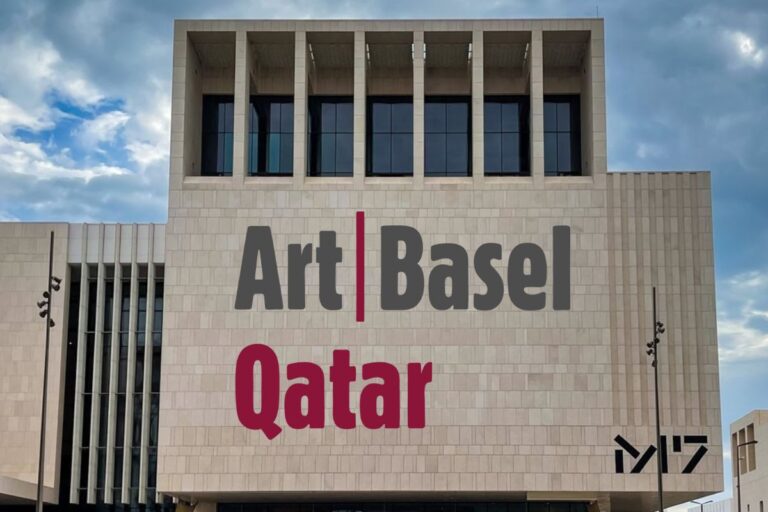
Art Basel Qatar represents a departure from the “copy-paste” model of international art fairs. Rather than a sprawling marketplace, the Doha edition feels edited and considered—a rhythm more akin to a museum exhibition than a traditional trade event.

The Power of the Solo-Presentation Model

The most significant structural shift in Doha is the move away from multi-artist booth logic. By prioritizing presentations built around a single artist, the fair fundamentally alters the viewer’s engagement.

Instead of scanning a compressed inventory of “greatest hits,” visitors are invited to step into a singular artistic position. This shift forces a psychological deceleration; the fair design encourages visitors to slow down and engage with the depth of a specific practice rather than the breadth of a gallery’s stock.

Intentional Concentration vs. Global Scale

While Art Basel’s iterations in Miami Beach, Paris, or Hong Kong are defined by their overwhelming scale and high-decibel visual noise, Doha is intentionally concentrated. Despite its physical footprint within the Doha Design District, the fair can appear smaller than its reality because it is curated for legibility. It favors a “less but better” approach that prioritizes the clarity of the work over the volume of the participants.

Verticality: A Three-Tiered Architecture

The spatial logic of the M7 venue creates a vertical narrative that breaks the monotony of the “endless hall” experience. The fair is distributed across three distinct levels:

  • Area 1 (Ground Level): Serving as the gravitational entry point and high-energy core.

  • Area 2 (First Floor): A transition zone designed for a calmer, more breathable experience.

  • Area 3 (Second Floor): A space where the fair opens up again, offering the highest level of visual legibility.

While this vertical structure is designed to disperse the crowd, the initial preview demonstrated the challenges of this layout. The ground level naturally becomes a high-intensity pressure point, particularly when high-profile attendance—such as the presence of the Emir of Qatar—necessitates heightened security and draws concentrated attention. These moments of congestion create a brief contradiction between a fair designed for “slow looking” and the logistical realities of a major state-supported event.

The Strategic Value for Collectors

The “editorial” nature of Art Basel Qatar offers a distinct advantage for serious collectors. By treating each booth as a single argument, the fair provides:

  1. Narrative Clarity: Presentations read as cohesive chapters rather than a rack of disparate names.

  2. Artistic Depth: Collectors can sense an artist’s internal logic, moving beyond the “hero work” to understand the full practice.

  3. Intellectual Longevity: The fair prioritizes long-term memory of specific artistic positions over temporary market heat.

Global Gravity vs. Regional Resonance

The exhibitor mix at Art Basel Qatar functions as a strategic bridge. It balances the institutional weight of global blue-chip galleries with a serious commitment to regional representation—an essential signal in a landscape where the primary question is not just what arrives from abroad, but which local and regional voices are being amplified.

A selective snapshot of the fair’s most notable gallery-artist pairings illustrates this curated approach:

  • Gagosian: A focused look at Christo’s early sculptural works from the late 1950s, highlighting themes of containment and displacement.

  • Hauser & Wirth: An intimate survey of Philip Guston, tracing his transition from abstraction to his influential late-period figuration.

  • David Zwirner: A powerful presentation of Marlene Dumas, whose work explores the complexities of identity and conflict.

  • White Cube: Large-scale works by Georg Baselitz, anchoring the fair’s European expressionist presence.

  • Pace Gallery: The fluid, organic bronze and polyurethane forms of Lynda Benglis.

  • Galerie Chantal Crousel: A rigorous presentation of Mona Hatoum, utilizing domestic materials to explore global themes of constraint.

  • October Gallery: The masterful, draped metal tapestries of El Anatsui.

  • The Third Line: A homecoming presentation for Sophia Al-Maria, whose “HiLux” installation reclaims Gulf Futurism through the lens of Bedouin car culture.

  • Tabari Artspace: A deep dive into Hazem Harb’s explorations of Palestinian architecture and memory.

  • Athr Gallery: Ahmed Mater’s “Temporal Migration,” a photographic survey documenting the shifting urban and social landscape of Makkah.

  • al markhiya gallery: New works by Qatari artist Bouthayna Al Muftah, whose practice translates local heritage into contemporary visual language.

The Memory of the Singular

Even within a brief visit, the fair’s ultimate strength becomes obvious: it is structured to be remembered through singular artistic encounters, not through accumulation. By rejecting the traditional multi-artist booth in favor of authored, editorial positions, Art Basel Qatar ensures that what lingers is not the noise of the market, but the clarity of the work itself.

Verified by MonsterInsights