Tag

National Gallery London

Browsing

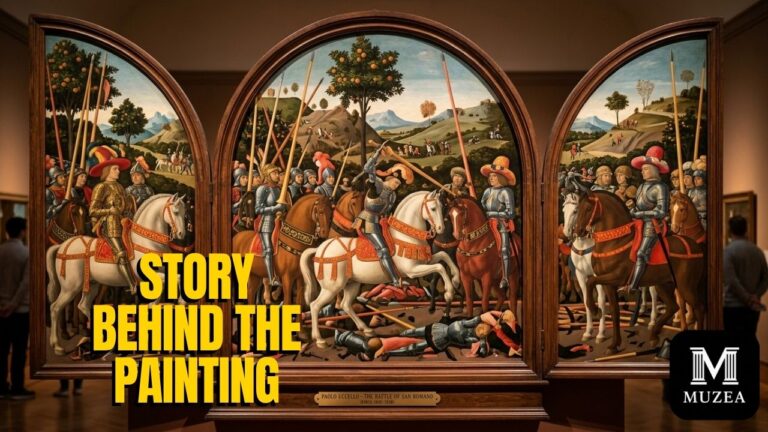
Imagine a 15th-century masterpiece that feels less like a static image and more like an action movie—horses rearing, lances breaking, and soldiers thrown backward in mid-air. Welcome to the world of Paolo Uccello’s The Battle of San Romano.

In the fourth episode of Story Behind the Painting, we explore how a relatively small skirmish in 1432 between Florence and Lucca became one of the most famous examples of propaganda, mathematics, and “ceremonial war” in the history of the Italian Renaissance.


A Triptych Divided Across Europe

Today, the Battle of San Romano is a massive work composed of three separate panels. Interestingly, you have to travel across Europe to see the full story:

  • The Dawn (The London Panel): Housed in the National Gallery, London [07:07].

  • The Heat of Battle (The Florence Panel): Located in the Galleria degli Uffizi, Florence [09:29].

  • The Counterattack (The Paris Panel): Found in the Musée du Louvre, Paris [10:41].

500 years ago, however, these panels hung together in the Medici Palace. In fact, Lorenzo de’ Medici loved the paintings so much that he “forcibly moved” them from the Bartolini family villa to his own palace to use them as a ultimate power “flex” [01:51].


The Business of “Bloodless” War

To understand this painting, you have to understand 15th-century Italy. It wasn’t a unified country but a patchwork of wealthy kingdoms that hired private mercenary armies known as Condottieri [04:12].

War was a business, and these “War CEOs” were expensive assets. As a result, battles were often surprisingly bloodless. Mercenaries avoided killing each other because a dead opponent meant the war (and the paycheck) ended [06:04]. Machiavelli famously mocked these conflicts, saying they began without fear and ended without losses [05:48]. Uccello’s painting reflects this: the scene is clean, filled with gold leaf and bright colors, and remarkably free of blood [05:23].

Act I: The Dawn of the Red Hat

The London panel introduces our protagonist, Niccolò da Tolentino [07:17]. You can’t miss him—he’s wearing a massive, bright red and gold velvet hat called a mazzocchio.

While completely impractical for a real fight, the hat serves as a mythological “flex.” It shows Niccolò not just as a soldier, but as an emblematic, visionary leader. In the background, you can see two knights riding away from the center of the fray; they are messengers sent to notify allies that Niccolò is being outnumbered and needs a counterattack [09:12].

Act II: The Unseating of the Enemy

In the Florence panel, we see the turning point of the battle. The Sienese commander, Bernardino della Carda, is literally being unseated from his horse by a Florentine lance [09:37]. Uccello uses this panel to “stack” the scene, showing Florentine soldiers beginning to surround the enemy behind hills and in the distance.

Act III: The Arrival of the Cavalry

The final act in Paris shows the decisive counterattack led by Micheletto Attendolo [10:49]. Having received the message from the first panel, Micheletto arrives just in time to hit the Sienese flank. Once he arrived, the “math” of the battle changed, and the Sienese forces accepted defeat [11:39].


A Revolution in Mathematics: The Persistence of Perspective

While the battle was about propaganda, the execution of the painting was about a revolution in mathematics. Paolo Uccello was obsessed with linear perspective [00:43].

In the London panel, look at the broken lances on the ground. They aren’t scattered randomly; they are meticulously aligned to point toward a vanishing point, creating a radical sense of depth and three-dimensionality [12:05].

Uccello was also a master of foreshortening—painting objects (like the fallen soldier in the bottom left) at an angle to show depth [13:53]. To Uccello, battle was a mess, but geometry was order. By applying these strict rules, he turned a chaotic skirmish into an aesthetically pleasing, eternal stage.

The Medici Mark

When the paintings were moved to the Medici Palace, they had to be altered to fit the walls. The tops were cut, and the Medici added their own family symbol to the landscape: oranges [14:33]. In the 15th century, owning fresh oranges was the equivalent of owning a supercar today—a final, fruity layer of propaganda on an already legendary work.


Watch the full analysis here:
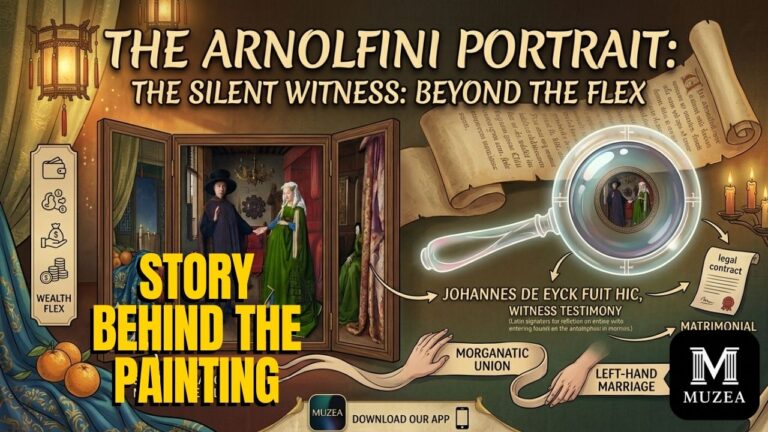
In the mid-15th century, the city of Bruges was the commercial beating heart of Northern Europe. It was a place where Russian furs, Venetian silks, and Spanish oranges collided in a vibrant display of global trade. In this world of rising merchant power, few objects capture the era’s opulence and mystery quite like Jan van Eyck’s 1434 masterpiece, The Arnolfini Portrait (also known as The Arnolfini Marriage).

In the third episode of Story Behind the Painting, we peel back the layers of this iconic oil painting to discover that what looks like a simple wedding portrait is actually a complex legal document, a high-stakes “flex” of wealth, and a masterpiece of Northern Renaissance detail.


The Best of the Best: A Statement of Power

To understand the weight of this painting, one must first look at the artist. Jan van Eyck was the court painter for the Valois dukes of Burgundy—the highest tier of artistic prestige at the time. For the merchant Giovanni di Nicolao Arnolfini and his wife to hire him was a massive statement [03:33]. It was the 15th-century equivalent of a tech CEO hiring a celebrity photographer usually reserved for royalty.

While the Italian Renaissance focused on human physiology and muscles, the Northern Renaissance, led by competitors like Robert Campin and Jan van Eyck, was obsessed with the context and surroundings [02:40]. Every object in the room was placed there with intent.


Subtle Flexing: Oranges, Fur, and Blue Silk

The Arnolfini couple didn’t just want to show they were rich; they wanted to show they were connected.

  • The Blue Textile: The bride’s gown features a vibrant blue, a color that was incredibly expensive and often reserved for royalty [05:22].

  • The Oranges: On the windowsill and chest sit fresh oranges. In 1434 Bruges, these were exotic luxuries imported from Spain or Portugal, costing a fortune to keep fresh [05:29].

  • Excessive Fabric: The bride’s gown is heavy with swathes of extra material. This wasn’t just fashion; it was a sign that they could afford not only the cloth but the servants required to carry and maintain such a cumbersome garment [07:16].

  • The Fur: Both garments are trimmed with expensive furs like mink and sable. Giovanni’s robe is cut to calf-length, signaling he is a “man of action” who needs to move freely for his business [08:44].


The Mystery of the Left Hand: A “Morganatic” Marriage?

One of the most debated details is the way the couple holds hands. Giovanni is offering his left hand, not his right [12:33].

This suggests a “Morganatic marriage” or a “left-hand marriage.” In 15th-century society, this usually occurred when a man of high status married a woman from a lower social class. This type of union came with two strict conditions for the bride [15:55]:

  1. She and her future children relinquished all inheritance rights to the husband’s noble estate.

  2. Her children would not continue the noble family lineage.

In exchange, she was guaranteed financial security if she became a widow. This painting, therefore, likely served as a visual matrimonial contract, documenting the terms of their union in an age before formal church marriage certificates were mandatory [15:12].


The Convex Mirror: A Window to the Artist

At the center of the painting hangs a curved, convex mirror—a technological marvel of the time. Producing a flat mirror was nearly impossible; instead, glassblowers would blow a sphere, coat the inside with mercury and tin, and then cut out a circular section [11:12].

If you look closely at the mirror’s frame, it is decorated with ten tiny medallions depicting the Passion of Christ [11:47]. But even more striking is the reflection itself. In the mirror, you can see two figures entering the room. Above the mirror, Van Eyck wrote in elaborate Latin script: “Johannes de Eyck fuit hic”Jan van Eyck was here [12:14].

This wasn’t just a signature; it was a legal testimony. He was acting as a witness to the marriage contract, a role that would later inspire other great painters like Velázquez in his work Las Meninas [18:22].


Symbols of the Soul

Beyond the wealth and law, the painting is filled with spiritual and domestic symbols:

  • The Dog: A small Brussels Griffon sits at the couple’s feet, symbolizing fidelity and a nurturing home environment [09:46].

  • The Shoes: Removed and placed to the side, the discarded clogs suggest that the couple is standing on “holy ground,” as marriage was considered a sacred sacrament [09:06].

  • The Single Candle: One lit candle in the chandelier during the daytime is often interpreted as the all-seeing eye of God or the presence of the Holy Spirit witnessing the union.

Conclusion

The Arnolfini Portrait is a testament to the power of the Northern Renaissance. It shows a world where art was used as a tool for social positioning, legal protection, and religious devotion. Today, it hangs in the National Gallery in London, continuing to fascinate viewers with its “inception-like” details and the silent testimony of a painter who was “there” nearly 600 years ago.


Watch the full episode here:

Verified by MonsterInsights