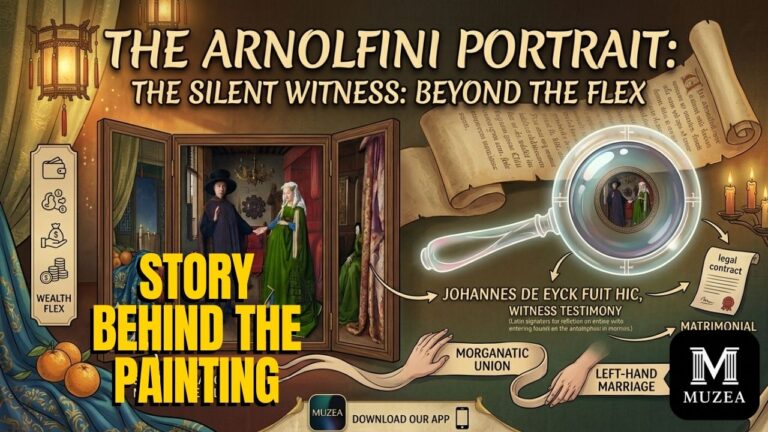
In the mid-15th century, the city of Bruges was the commercial beating heart of Northern Europe. It was a place where Russian furs, Venetian silks, and Spanish oranges collided in a vibrant display of global trade. In this world of rising merchant power, few objects capture the era’s opulence and mystery quite like Jan van Eyck’s 1434 masterpiece, The Arnolfini Portrait (also known as The Arnolfini Marriage).
In the third episode of Story Behind the Painting, we peel back the layers of this iconic oil painting to discover that what looks like a simple wedding portrait is actually a complex legal document, a high-stakes “flex” of wealth, and a masterpiece of Northern Renaissance detail.
The Best of the Best: A Statement of Power
To understand the weight of this painting, one must first look at the artist. Jan van Eyck was the court painter for the Valois dukes of Burgundy—the highest tier of artistic prestige at the time. For the merchant Giovanni di Nicolao Arnolfini and his wife to hire him was a massive statement [03:33]. It was the 15th-century equivalent of a tech CEO hiring a celebrity photographer usually reserved for royalty.
While the Italian Renaissance focused on human physiology and muscles, the Northern Renaissance, led by competitors like Robert Campin and Jan van Eyck, was obsessed with the context and surroundings [02:40]. Every object in the room was placed there with intent.
Subtle Flexing: Oranges, Fur, and Blue Silk
The Arnolfini couple didn’t just want to show they were rich; they wanted to show they were connected.
-
The Blue Textile: The bride’s gown features a vibrant blue, a color that was incredibly expensive and often reserved for royalty [05:22].
-
The Oranges: On the windowsill and chest sit fresh oranges. In 1434 Bruges, these were exotic luxuries imported from Spain or Portugal, costing a fortune to keep fresh [05:29].
-
Excessive Fabric: The bride’s gown is heavy with swathes of extra material. This wasn’t just fashion; it was a sign that they could afford not only the cloth but the servants required to carry and maintain such a cumbersome garment [07:16].
-
The Fur: Both garments are trimmed with expensive furs like mink and sable. Giovanni’s robe is cut to calf-length, signaling he is a “man of action” who needs to move freely for his business [08:44].
The Mystery of the Left Hand: A “Morganatic” Marriage?
One of the most debated details is the way the couple holds hands. Giovanni is offering his left hand, not his right [12:33].
This suggests a “Morganatic marriage” or a “left-hand marriage.” In 15th-century society, this usually occurred when a man of high status married a woman from a lower social class. This type of union came with two strict conditions for the bride [15:55]:
-
She and her future children relinquished all inheritance rights to the husband’s noble estate.
-
Her children would not continue the noble family lineage.
In exchange, she was guaranteed financial security if she became a widow. This painting, therefore, likely served as a visual matrimonial contract, documenting the terms of their union in an age before formal church marriage certificates were mandatory [15:12].
The Convex Mirror: A Window to the Artist
At the center of the painting hangs a curved, convex mirror—a technological marvel of the time. Producing a flat mirror was nearly impossible; instead, glassblowers would blow a sphere, coat the inside with mercury and tin, and then cut out a circular section [11:12].
If you look closely at the mirror’s frame, it is decorated with ten tiny medallions depicting the Passion of Christ [11:47]. But even more striking is the reflection itself. In the mirror, you can see two figures entering the room. Above the mirror, Van Eyck wrote in elaborate Latin script: “Johannes de Eyck fuit hic”—Jan van Eyck was here [12:14].
This wasn’t just a signature; it was a legal testimony. He was acting as a witness to the marriage contract, a role that would later inspire other great painters like Velázquez in his work Las Meninas [18:22].
Symbols of the Soul
Beyond the wealth and law, the painting is filled with spiritual and domestic symbols:
-
The Dog: A small Brussels Griffon sits at the couple’s feet, symbolizing fidelity and a nurturing home environment [09:46].
-
The Shoes: Removed and placed to the side, the discarded clogs suggest that the couple is standing on “holy ground,” as marriage was considered a sacred sacrament [09:06].
-
The Single Candle: One lit candle in the chandelier during the daytime is often interpreted as the all-seeing eye of God or the presence of the Holy Spirit witnessing the union.
Conclusion
The Arnolfini Portrait is a testament to the power of the Northern Renaissance. It shows a world where art was used as a tool for social positioning, legal protection, and religious devotion. Today, it hangs in the National Gallery in London, continuing to fascinate viewers with its “inception-like” details and the silent testimony of a painter who was “there” nearly 600 years ago.
Watch the full episode here: