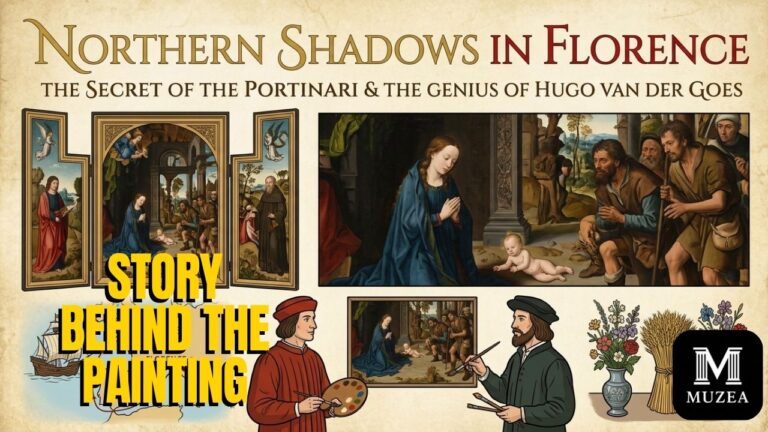
In the heart of the Galleria degli Uffizi in Florence, amidst the sun-drenched frescoes and elegant tempera panels of the Italian masters, sits a monumental work that feels like a cold, brilliant wind from the North. Spanning a staggering six meters in width, the Portinari Altar is more than just a painting; it is a bridge between two worlds.
In the tenth episode of The Story Behind the Painting, we explore the “Northern Shadows” cast by this masterpiece and the troubled genius of its creator, the Flemish master Hugo van der Goes.
A Secret Weapon: The Flemish Oil Technique
When the Portinari Altar arrived in Florence in 1483, it didn’t just impress the local artists—it stunned them. At a time when Italian masters were still largely perfecting egg tempera, Van der Goes arrived with a “secret weapon”: oil paint on large oak panels [01:46].
By utilizing linseed and walnut oils, Hugo could apply paint in translucent glazes. This technique allowed for a level of hyper-realism and depth that fresco simply couldn’t match. Notice the deep lapis lazuli of the Virgin Mary’s robe and the glowing crimson of the angels [02:08]; they seem to emit light from within, an optical effect that changed the course of Florentine art forever.
The Banker’s Legacy and a Nautical Odyssey
The painting exists because of the ambition of Tommaso Portinari, a shrewd Italian banker representing the Medici Bank in Bruges. Portinari wanted a monument to cement his legacy in both his adopted northern home and his native Florence [02:47].
The journey of the altarpiece was a 15th-century logistical miracle. Because of its immense weight and the fragility of the oak, it couldn’t be hauled over the Alps. Instead, it traveled by sea, sailing from the North Sea, around Spain, and into the Mediterranean [03:10]. When it finally reached Florence on May 28, 1483, it took 16 porters to carry the heavy crates to the high altar of the church of San Egidio [03:38].
A Nativity Drenched in Symbolism
While Italian versions of the Nativity—like those by Botticelli—often feel airy and celebratory, Van der Goes presents a scene of heavy tension and stark realism [04:05].
-
The Virgin Mary: She is not a radiant young mother but a somber figure. Her hands are joined in a prayer that looks like a plea, and her robe is a blue so deep it borders on black—the color of mourning [04:16]. Even at her son’s birth, she contemplates his eventual death.
-
The Infant Christ: Christ does not lie in a soft manger. Following the visions of St. Bridget of Sweden, he lies naked on the cold, hard earth [04:50]. This symbolizes his humility and his role as the “bread of life” fallen to earth.
-
The Flowers: In the foreground, two vases of flowers act as a theological map. The scarlet lily represents the blood of the Passion, while the white and blue irises symbolize purity and the “Seven Sorrows” of the Virgin [07:47].
-
The Architecture: Behind the scene, a shattered Romanesque building represents the “Old Law” crumbling to make way for the “New Law” brought by Christ [06:54].
The Rugged Realism of the Shepherds
One of the most revolutionary aspects of the Portinari Altar is the depiction of the shepherds. In Italian art, these figures were often idealized. Van der Goes, however, painted them as rugged, weathered men with calloused hands and gaps in their teeth [08:24].
There is a frantic, almost breathless energy in their faces—a psychological realism that was entirely new to the history of art [10:33]. They represent the common people, captured with a “disastrous realism” that shocked 15th-century viewers.
Hugo van der Goes: The Original Troubled Genius
To understand the intensity of the painting, one must understand the man who painted it. Hugo van der Goes was a titan of his era, serving as the dean of the Ghent Guild of St. Luke and managing lavish decorations for the Burgundian court [09:11].
Yet, at the height of his fame in 1477, he walked away from worldly success to enter the Red Cloister monastery near Brussels [09:38]. Despite his religious devotion, Hugo struggled with a profound spiritual desolation often called “melancholy.”
The chronicles of his fellow monk, Gaspar Ofhuys, provide a moving account of Hugo’s later years. He suffered from a deep conviction of his own unworthiness, fueled by the pressure to perfect the Portinari Altar and the conflict between his artistic pride and his humble faith [11:19]. Long before Vincent van Gogh, Hugo was the original “troubled genius,” a man whose creative fire was inextricably linked to his emotional depth.
An Enduring Legacy
The Portinari Altar was a “lightning bolt” for Florence [12:10]. Masters like Ghirlandaio and even a young Leonardo da Vinci studied its textures and its use of light. It remains a painting of profound contradictions:
-
A celebration of birth that whispers of death.
-
A display of immense wealth commissioned by a banker, centered on a child lying on the cold, hard ground.
Today, it stands in the Uffizi as a testament to the soul of an artist who poured the entire weight of the human experience into every brushstroke [12:02].
For more deep dives into the world’s most iconic masterpieces, watch the full episode on the