Tag

Art Symbolism

Browsing

In the bustling streets of 15th-century Florence, graduation didn’t involve a cap and gown. Instead, for the sons of wealthy merchants and bankers, the transition to adulthood was marked by a “journey of initiation.” It was a high-stakes business trip across bandit-filled forests and over the treacherous Alps to learn the family trade.

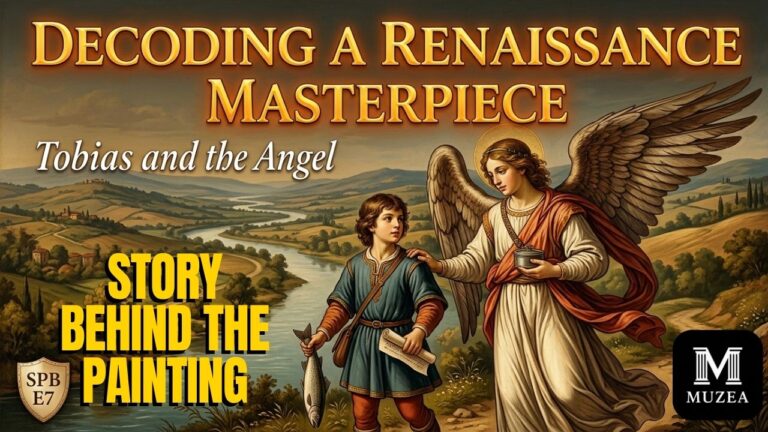
The latest episode of Story Behind the Painting by MUZEA takes us deep into a masterpiece that served as the “visual mascot” for these nervous fathers and ambitious sons: Tobias and the Angel (c. 1469), painted by the legendary brothers Antonio and Piero del Pollaiuolo.

More Than a Bible Story

At first glance, the painting depicts a scene from the Book of Tobit. Young Tobias is sent by his blind father to collect a debt in a distant city. But as the episode reveals, the Pollaiuolo brothers weren’t just retelling scripture; they were painting the lived reality of the Florentine elite [00:19].

Tobias represents the next generation of the merchant class. In his hand, he carries a small roll of parchment. In the 1400s, this wasn’t just a letter—it was a bill of exchange [01:23]. This “high-tech” financial tool allowed bankers to move vast sums of money across borders without carrying heavy, target-painting bags of gold. It was the Renaissance equivalent of a wire transfer.

The Ultimate Mentor: Archangel Raphael

The journey was dangerous, which is why Tobias isn’t alone. He is accompanied by the Archangel Raphael, often called the “Angel of Safe Conduct” [01:49].

The episode highlights a fascinating detail: the striking similarity between the faces of Tobias and the Angel. This suggests a “guardian twin” concept—the idea that every person has a heavenly double guiding them. Raphael is the ultimate mentor, the “heavenly double” of the young apprentice, providing divine protection as the boy navigates the “mission of trust” [02:19].

The Symbolism of the Fish and the Dog

Two animals play crucial roles in this composition:

  1. The Fish: Tobias carries a fish caught from the Tigris River [02:56]. While it literally refers to the source of the medicine needed to cure his father’s blindness, it also acts as a “code.” In mercantile culture, it was a symbol of validity, and spiritually, it represented Christ (via the Greek acrostic ichthus).

  2. The Dog: A small, fluffy dog trots ahead of the pair. In art history, the dog is the universal symbol of fidelity and loyalty [04:51]—essential traits for a young man trusted with the family’s wealth and reputation.

The “Power Duo” Behind the Canvas

The episode dives into the fascinating history of the artists, Antonio and Piero del Pollaiuolo. Interestingly, “Pollaiuolo” wasn’t their real last name; it was a nickname derived from their father’s job as a poultry seller (pollo meaning hen coop in Italian) [06:27].

While their father dealt in chickens, the brothers had much loftier ambitions. They became the “Silicon Valley” of their day, experimenting with revolutionary techniques:

  • The Oil Revolution: At a time when most Italian artists used flat, matte egg tempera, the Pollaiuolos were among the first to use translucent oil glazes [05:48]. This is why the fabrics in the painting—the crimson jackets, velvet, and silk—shimmer with such realistic depth.

  • Anatomical Outlaws: Legend has it the brothers were the first to perform human dissections [07:41]. They didn’t want to just paint a figure; they wanted to show the tension of skin over flexing muscle, a pursuit that would later influence Michelangelo.

  • The Cinematic Landscape: The background shows the Arno Valley with a high vantage point, giving the painting a “cinematic drone shot feel” that was revolutionary for the 1460s [08:20].

Why It Matters Today

The beauty of Tobias and the Angel lies in its humanity. As the narrator aptly puts it, the painting represents the universal bridge between childhood and adult responsibility [09:56].

Whether it’s a Florentine teenager in 1469 clutching a bill of exchange or a modern graduate heading to their first internship, the feeling remains the same: a mix of fear, excitement, and the search for a mentor to show the way. The Pollaiuolo brothers didn’t just paint a religious scene; they captured the weight of expectations and the hope of a safe return.


Watch the full breakdown here:
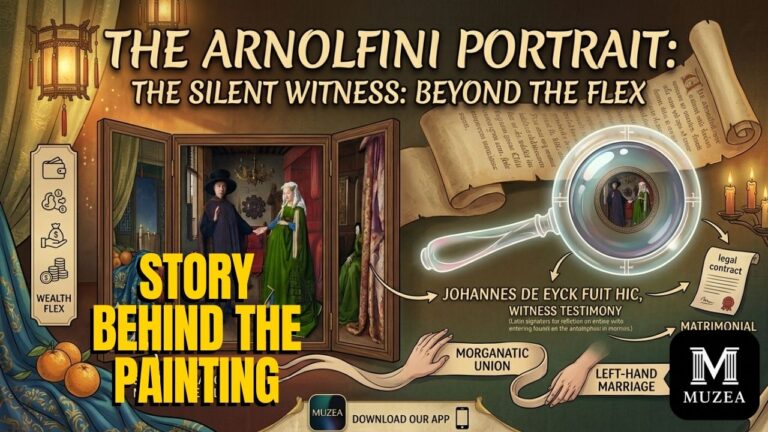
 

In the mid-15th century, the city of Bruges was the commercial beating heart of Northern Europe. It was a place where Russian furs, Venetian silks, and Spanish oranges collided in a vibrant display of global trade. In this world of rising merchant power, few objects capture the era’s opulence and mystery quite like Jan van Eyck’s 1434 masterpiece, The Arnolfini Portrait (also known as The Arnolfini Marriage).

In the third episode of Story Behind the Painting, we peel back the layers of this iconic oil painting to discover that what looks like a simple wedding portrait is actually a complex legal document, a high-stakes “flex” of wealth, and a masterpiece of Northern Renaissance detail.


The Best of the Best: A Statement of Power

To understand the weight of this painting, one must first look at the artist. Jan van Eyck was the court painter for the Valois dukes of Burgundy—the highest tier of artistic prestige at the time. For the merchant Giovanni di Nicolao Arnolfini and his wife to hire him was a massive statement [03:33]. It was the 15th-century equivalent of a tech CEO hiring a celebrity photographer usually reserved for royalty.

While the Italian Renaissance focused on human physiology and muscles, the Northern Renaissance, led by competitors like Robert Campin and Jan van Eyck, was obsessed with the context and surroundings [02:40]. Every object in the room was placed there with intent.


Subtle Flexing: Oranges, Fur, and Blue Silk

The Arnolfini couple didn’t just want to show they were rich; they wanted to show they were connected.

  • The Blue Textile: The bride’s gown features a vibrant blue, a color that was incredibly expensive and often reserved for royalty [05:22].

  • The Oranges: On the windowsill and chest sit fresh oranges. In 1434 Bruges, these were exotic luxuries imported from Spain or Portugal, costing a fortune to keep fresh [05:29].

  • Excessive Fabric: The bride’s gown is heavy with swathes of extra material. This wasn’t just fashion; it was a sign that they could afford not only the cloth but the servants required to carry and maintain such a cumbersome garment [07:16].

  • The Fur: Both garments are trimmed with expensive furs like mink and sable. Giovanni’s robe is cut to calf-length, signaling he is a “man of action” who needs to move freely for his business [08:44].


The Mystery of the Left Hand: A “Morganatic” Marriage?

One of the most debated details is the way the couple holds hands. Giovanni is offering his left hand, not his right [12:33].

This suggests a “Morganatic marriage” or a “left-hand marriage.” In 15th-century society, this usually occurred when a man of high status married a woman from a lower social class. This type of union came with two strict conditions for the bride [15:55]:

  1. She and her future children relinquished all inheritance rights to the husband’s noble estate.

  2. Her children would not continue the noble family lineage.

In exchange, she was guaranteed financial security if she became a widow. This painting, therefore, likely served as a visual matrimonial contract, documenting the terms of their union in an age before formal church marriage certificates were mandatory [15:12].


The Convex Mirror: A Window to the Artist

At the center of the painting hangs a curved, convex mirror—a technological marvel of the time. Producing a flat mirror was nearly impossible; instead, glassblowers would blow a sphere, coat the inside with mercury and tin, and then cut out a circular section [11:12].

If you look closely at the mirror’s frame, it is decorated with ten tiny medallions depicting the Passion of Christ [11:47]. But even more striking is the reflection itself. In the mirror, you can see two figures entering the room. Above the mirror, Van Eyck wrote in elaborate Latin script: “Johannes de Eyck fuit hic”Jan van Eyck was here [12:14].

This wasn’t just a signature; it was a legal testimony. He was acting as a witness to the marriage contract, a role that would later inspire other great painters like Velázquez in his work Las Meninas [18:22].


Symbols of the Soul

Beyond the wealth and law, the painting is filled with spiritual and domestic symbols:

  • The Dog: A small Brussels Griffon sits at the couple’s feet, symbolizing fidelity and a nurturing home environment [09:46].

  • The Shoes: Removed and placed to the side, the discarded clogs suggest that the couple is standing on “holy ground,” as marriage was considered a sacred sacrament [09:06].

  • The Single Candle: One lit candle in the chandelier during the daytime is often interpreted as the all-seeing eye of God or the presence of the Holy Spirit witnessing the union.

Conclusion

The Arnolfini Portrait is a testament to the power of the Northern Renaissance. It shows a world where art was used as a tool for social positioning, legal protection, and religious devotion. Today, it hangs in the National Gallery in London, continuing to fascinate viewers with its “inception-like” details and the silent testimony of a painter who was “there” nearly 600 years ago.


Watch the full episode here:

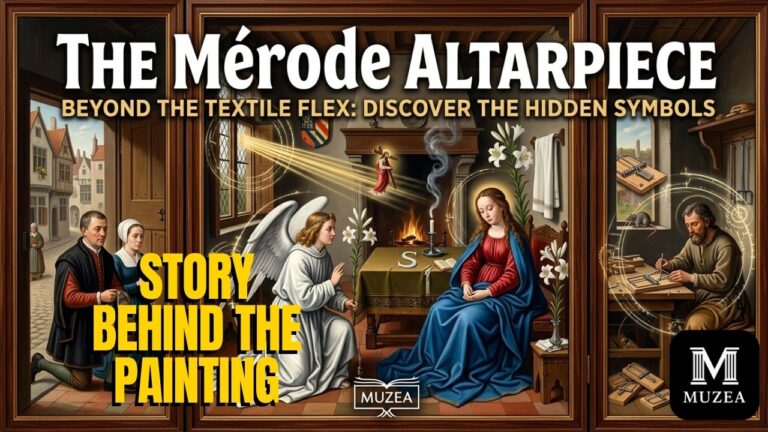
In the modern world, we “flex” our success through designer clothes, high-end smartphones, or luxury travel. In the 15th century, however, the ultimate status symbol wasn’t a car—it was a commissioned painting. But as the latest episode of Story Behind the Painting reveals, the Mérode Altarpiece (or the Annunciation Triptych) by Robert Campin was more than just a display of wealth; it was a complex blend of marketing, domestic prayer, and revolutionary artistic detail.

The Ultimate Textile Flex

Unlike most grand altarpieces of the era, this work wasn’t commissioned by a priest for a cathedral. Instead, it was paid for by a wealthy merchant, likely from the Inghelbrecht family (identified by the coat of arms in the window) [01:39].

Because the client made his fortune in textiles, the painting is essentially a high-end advertisement for his business. Look closely at the robes of the Angel Gabriel and the Virgin Mary—the fabric is heavy, voluminous, and folded with such precision that it dominates the frame. By showcasing such “finesse” in the rendering of cloth, the merchant was subtly promoting the quality of his own wares [01:20].

A Home for the Holy

The Mérode Altarpiece was designed as a home altar. Measuring roughly two feet tall, it was intended for private devotion in a middle-class Dutch home [01:54]. The owners would kneel before it to pray to Mary, often asking for the blessing of children.

What makes this painting a masterpiece of the Northern Renaissance is its setting. While Italian artists were obsessed with the idealized human body and mathematical perspective, Northern artists like Campin focused on hyper-realistic textures and domestic interiors. Through the use of oil paint, Campin captured:

  • The rust on iron nails [03:30].

  • The delicate feathers of an angel’s wings.

  • Double shadows cast on the walls, suggesting two light sources—the window and the open door—a level of “ray tracing” that was centuries ahead of its time [05:41].

Hidden Symbols in Every Corner

The central panel depicts the Annunciation—the moment Gabriel tells Mary she will bear the Son of God. But Campin strips away the traditional golden halos to make the figures feel more human and accessible [05:07]. Instead, holiness is signaled through everyday objects:

  • The Tiny Jesus: Look for a small figure carrying a cross flying through the window on seven beams of light [05:25].

  • Purity Symbols: The white lilies, the clean white towel, and the polished water pot all represent Mary’s virginity.

  • The Extinguished Candle: A thin wisp of smoke rises from a candle that was just blown out. Some suggest this represents the moment the Divine enters the physical world, 혹은 perhaps a draft from the open door [06:08].

Joseph and the Mouse Traps

The right panel features Joseph in his workshop, and it contains one of the most famous “Easter eggs” in art history: mouse traps [06:54]. One sits on his workbench, and another is displayed on the window ledge outside.

While some theologians argue the trap symbolizes Christ as the “bait” to catch the devil, there’s a more practical theory related to the time. The 15th century was still reeling from the Black Plague, which people knew was carried by rats. By showing Joseph making mouse traps, the painting portrays him as a provider and a protector—keeping the home safe from both physical disease and spiritual evil [07:37].

The World Outside the Window

While the interior feels peaceful, the world outside was anything but. The 15th century was defined by the Hundred Years’ War, English occupations, and civil unrest in cities like Paris and Ghent [02:46]. This painting offers a rare, idealized glimpse of peaceful Dutch streets, contrasting the chaos of the era with the eternal calm of the divine [02:39].

A Modern Twist

The episode concludes with a playful “updated” version of the triptych created by AI. In this modern reimagining, the holy family lives in a cramped apartment (due to the housing crisis), Joseph is a software engineer protecting the home from cyber attacks, and the angel Gabriel might have a hard time fitting through the small windows [09:46]!

Whether viewed in the 1400s or through a digital lens today, the Mérode Altarpiece remains a testament to the power of detail and the enduring intersection of the sacred and the mundane.


Watch the full analysis here:

Verified by MonsterInsights