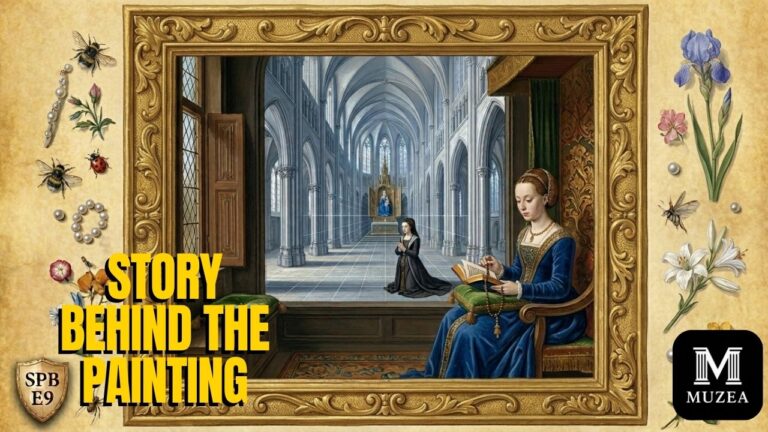
Imagine holding a device in the late 1470s that could transport you from a quiet, candlelit room into the soaring, silver-lit nave of a massive Gothic cathedral. It’s not a headset or a screen; it’s a book. Specifically, it’s the Hours of Mary of Burgundy, a masterpiece of Flemish illumination that the latest episode of Story Behind the Painting by MUZEA describes as the “virtual reality” of the 15th century.
The Window Miniature: A Visual Revolution
The centerpiece of this episode is the “window miniature,” a painting so advanced it feels like a trick of the eye—or more accurately, a trompe l’oeil [02:38].
The painting depicts a woman, Mary of Burgundy, sitting by a window and reading her prayer book. But as you look through that window, you see a second version of Mary, kneeling before the Virgin and Child inside a cathedral [02:22]. This is “simultaneous reality” [03:32]:
-
The Physical Mary: Sits in the “now,” touching her prayer beads and reading.
-
The Spiritual Mary: Exists inside the sacred vision she is reading about.
The artist uses linear perspective to pull the viewer’s eye into the depths of the cathedral, creating a sense of infinite space on a piece of vellum smaller than a standard iPad screen [01:49]. By treating the page’s edge as a physical windowsill, the artist turns flat parchment into a three-dimensional portal.
The Woman Behind the Book: The Most Sought-After Bachelorette
Mary of Burgundy was far from a fragile princess. At just 20 years old, she became the Duchess of Burgundy after her father, Charles the Bold, was killed in battle [05:02]. At the time, Burgundy was a “middle kingdom” stretching from Switzerland to the North Sea, controlling trade and cloth production—making it the wealthiest court in Europe [04:16].
Mary faced immense pressure from King Louis XI of France (known as the “Universal Spider” for his webs of lies), who tried to seize her lands and force her into marriage [05:17]. Amidst this chaos, this prayer book served as her private sanctuary.
Interestingly, Mary was also a vibrant athlete. She was a master of falconry, an expert equestrian, and loved ice skating on the frozen canals of Flanders [06:06]. Tragically, it was her love of the outdoors that led to her end; she died at just 25 after a horse-riding accident during a falcon hunt [06:41].
The Anonymous Master: The “Banksy” of the 1470s
The genius behind this work remains a mystery. Known only as the Vienna Master of Mary of Burgundy, this anonymous Flemish illuminator was a revolutionary [07:22].
Before his influence, medieval book illustrations were beautiful but flat. The Master introduced:
-
Trompe l’oeil Borders: He painted jewelry, glass vases, and flowers with realistic shadows so they appeared to sit on top of the page [08:05].
-
Atmospheric Perspective: He showed how light and air make distant objects paler and less sharp, as seen in the cool, silver light of the cathedral interior [08:22].
-
Introspective Emotion: Unlike the stiff symbols of previous eras, Mary’s face shows a quiet, pensive depth—a human soul in a moment of private reflection [08:40].
A Legacy of Light and Space
The Master of Mary of Burgundy was the founder of the Gent-Bruges School, the foremost center for manuscript illumination in Europe [09:01]. His techniques paved the way for the grand landscape paintings of the High Renaissance. Without his “window concept,” the shift from symbolic medieval art to the realistic perspective of the Renaissance might have looked very different.
When you look at this miniature, you aren’t just looking at a Duchess; you are looking at the ghost of a woman who was brave, athletic, and visionary, frozen forever in a moment where the material world ends and the divine imagination begins [04:07].
Explore the miniature in detail: