Tag

Religious Art

Browsing

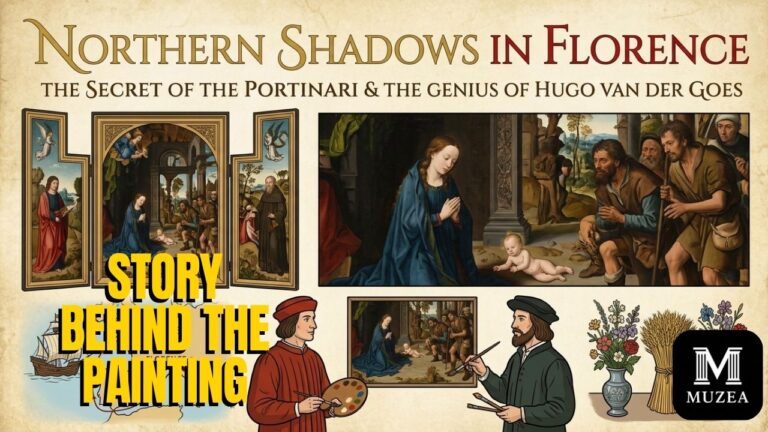
In the heart of the Galleria degli Uffizi in Florence, amidst the sun-drenched frescoes and elegant tempera panels of the Italian masters, sits a monumental work that feels like a cold, brilliant wind from the North. Spanning a staggering six meters in width, the Portinari Altar is more than just a painting; it is a bridge between two worlds.

In the tenth episode of The Story Behind the Painting, we explore the “Northern Shadows” cast by this masterpiece and the troubled genius of its creator, the Flemish master Hugo van der Goes.

A Secret Weapon: The Flemish Oil Technique

When the Portinari Altar arrived in Florence in 1483, it didn’t just impress the local artists—it stunned them. At a time when Italian masters were still largely perfecting egg tempera, Van der Goes arrived with a “secret weapon”: oil paint on large oak panels [01:46].

By utilizing linseed and walnut oils, Hugo could apply paint in translucent glazes. This technique allowed for a level of hyper-realism and depth that fresco simply couldn’t match. Notice the deep lapis lazuli of the Virgin Mary’s robe and the glowing crimson of the angels [02:08]; they seem to emit light from within, an optical effect that changed the course of Florentine art forever.

The Banker’s Legacy and a Nautical Odyssey

The painting exists because of the ambition of Tommaso Portinari, a shrewd Italian banker representing the Medici Bank in Bruges. Portinari wanted a monument to cement his legacy in both his adopted northern home and his native Florence [02:47].

The journey of the altarpiece was a 15th-century logistical miracle. Because of its immense weight and the fragility of the oak, it couldn’t be hauled over the Alps. Instead, it traveled by sea, sailing from the North Sea, around Spain, and into the Mediterranean [03:10]. When it finally reached Florence on May 28, 1483, it took 16 porters to carry the heavy crates to the high altar of the church of San Egidio [03:38].

A Nativity Drenched in Symbolism

While Italian versions of the Nativity—like those by Botticelli—often feel airy and celebratory, Van der Goes presents a scene of heavy tension and stark realism [04:05].

  • The Virgin Mary: She is not a radiant young mother but a somber figure. Her hands are joined in a prayer that looks like a plea, and her robe is a blue so deep it borders on black—the color of mourning [04:16]. Even at her son’s birth, she contemplates his eventual death.

  • The Infant Christ: Christ does not lie in a soft manger. Following the visions of St. Bridget of Sweden, he lies naked on the cold, hard earth [04:50]. This symbolizes his humility and his role as the “bread of life” fallen to earth.

  • The Flowers: In the foreground, two vases of flowers act as a theological map. The scarlet lily represents the blood of the Passion, while the white and blue irises symbolize purity and the “Seven Sorrows” of the Virgin [07:47].

  • The Architecture: Behind the scene, a shattered Romanesque building represents the “Old Law” crumbling to make way for the “New Law” brought by Christ [06:54].

The Rugged Realism of the Shepherds

One of the most revolutionary aspects of the Portinari Altar is the depiction of the shepherds. In Italian art, these figures were often idealized. Van der Goes, however, painted them as rugged, weathered men with calloused hands and gaps in their teeth [08:24].

There is a frantic, almost breathless energy in their faces—a psychological realism that was entirely new to the history of art [10:33]. They represent the common people, captured with a “disastrous realism” that shocked 15th-century viewers.

Hugo van der Goes: The Original Troubled Genius

To understand the intensity of the painting, one must understand the man who painted it. Hugo van der Goes was a titan of his era, serving as the dean of the Ghent Guild of St. Luke and managing lavish decorations for the Burgundian court [09:11].

Yet, at the height of his fame in 1477, he walked away from worldly success to enter the Red Cloister monastery near Brussels [09:38]. Despite his religious devotion, Hugo struggled with a profound spiritual desolation often called “melancholy.”

The chronicles of his fellow monk, Gaspar Ofhuys, provide a moving account of Hugo’s later years. He suffered from a deep conviction of his own unworthiness, fueled by the pressure to perfect the Portinari Altar and the conflict between his artistic pride and his humble faith [11:19]. Long before Vincent van Gogh, Hugo was the original “troubled genius,” a man whose creative fire was inextricably linked to his emotional depth.

An Enduring Legacy

The Portinari Altar was a “lightning bolt” for Florence [12:10]. Masters like Ghirlandaio and even a young Leonardo da Vinci studied its textures and its use of light. It remains a painting of profound contradictions:

  • A celebration of birth that whispers of death.

  • A display of immense wealth commissioned by a banker, centered on a child lying on the cold, hard ground.

Today, it stands in the Uffizi as a testament to the soul of an artist who poured the entire weight of the human experience into every brushstroke [12:02].


For more deep dives into the world’s most iconic masterpieces, watch the full episode on the
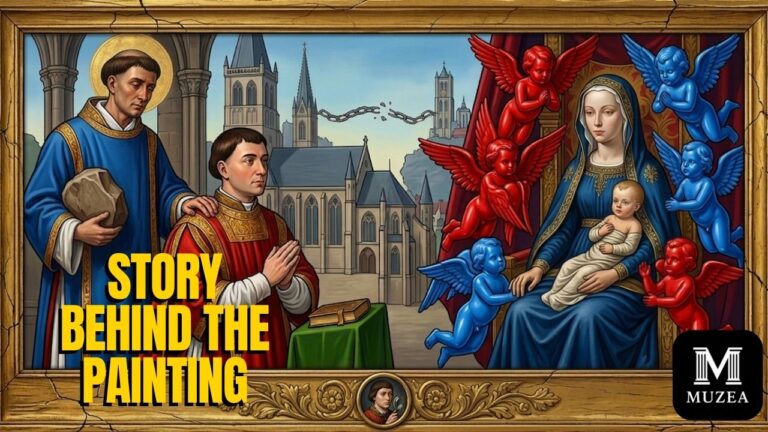
If you stumbled across the right panel of the Melun Diptych without context, you might assume it was a modern CGI render, a surrealist fever dream from the 1920s, or perhaps a high-fashion editorial. The Virgin Mary is startlingly pale, her hairline is plucked back to another zip code, and she sports a perfectly spherical, exposed breast.

But this isn’t modern art. It was painted in 1452 by Jean Fouquet, and it remains one of the most provocative, unhinged, and “messy” devotional paintings in history.


The Power Player: Etienne Chevalier

To understand this painting, we first have to meet the man who paid for it: Etienne Chevalier. In the 1450s, Etienne was the “CFO of France”—the royal treasurer for King Charles VII. A self-made man who rose through the ranks, he was described as incorruptible, trustworthy, and so close to the king that he was the executor of the royal will [03:00].

Etienne commissioned this diptych to hang over his wife’s tomb in the Church of Notre-Dame in Melun. In the left panel, we see Etienne himself in a permanent state of prayer. Standing behind him is his namesake, St. Stephen (Etienne in French).

St. Stephen is dressed as a deacon in stunning blue robes, but he’s carrying a gruesome “signature accessory”: a jagged, bloodstained stone resting on a book [03:25]. As the first Christian martyr, Stephen was stoned to death, and in medieval art, saints always carry the instruments of their demise like a grim fashion statement.

The Scandalous Madonna: Agnès Sorel

The right panel is where things get “spicy.” While the diptych was meant to honor Etienne’s late wife, the Virgin Mary looks nothing like her.

Art historians have long held an “open secret”: the model for the Virgin is believed to be Agnès Sorel, the “Lady of Beauty” and the official mistress of King Charles VII [04:13]. Etienne wasn’t just the king’s treasurer; he was one of Agnès’s closest friends.

By commissioning a painting where the king’s mistress is depicted as the Mother of God, Etienne was pulling off the ultimate 15th-century “flex.” He was signaling his proximity to power, his grief for a lost friend, and his hope for a VIP pass to heaven by knowing the right people. It’s a bizarre mix of humble devotion and high-society blasphemy [05:01].

The Artist from the Future: Jean Fouquet

If the Melun Diptych feels like it’s from another dimension, it’s because Jean Fouquet was an artist ahead of his time. Around 1446, Fouquet did a “study abroad” trip to Italy [05:37]. He was one of the few French painters of his era to study Italian linear perspective and 3D volume, even painting a portrait of Pope Eugenius IV while in Rome.

Fouquet was also a master miniaturist, accustomed to looking at the world through a magnifying glass. He used a technique involving melted glass (enamel) to give his work a high-gloss, high-definition finish that looks like a 4K screen [06:14].

The result is the Uncanny Valley. Look at the angels surrounding Mary: they aren’t soft or fluffy. They are monochromatic, bright red cherubim and blue seraphim that look like polished plastic figurines [07:08]. Fouquet used geometry and lighting in a robotic, supernatural way to create a high-fashion atmosphere that felt more like a “liminal space” than a traditional church.

A Long-Distance Tragedy

Today, the Melun Diptych is a victim of a “historical divorce.” During the French Revolution, the two halves were ripped apart. The left panel (the “boys”) now lives in Berlin, while the right panel (the “queen”) lives in Antwerp [07:48].

Scientists used dendrochronology (tree-ring dating) to prove the two panels are “soulmates”—both were cut from the exact same oak tree felled in 1446 [07:59]. Though they belong together, they haven’t shared a room in centuries.

The World’s First Selfie

Fouquet knew he was the “GOAT” (Greatest of All Time). He didn’t just paint the diptych; he signed it with a tiny enamel medallion of himself [08:18]. This is considered the oldest signed self-portrait in Western art history. He wanted the world to remember the name: Johes Fouquet.

The Melun Diptych serves as a reminder that people in the 1400s were just as obsessed with status, celebrity, and “aesthetic” as we are today. Next time you think your social media feed is too curated, just remember that Etienne Chevalier spent his life savings to be remembered forever standing next to the king’s mistress in a blue-and-red fever dream.


Stay curious. Stay messy.

Watch the full episode on MUZEA:

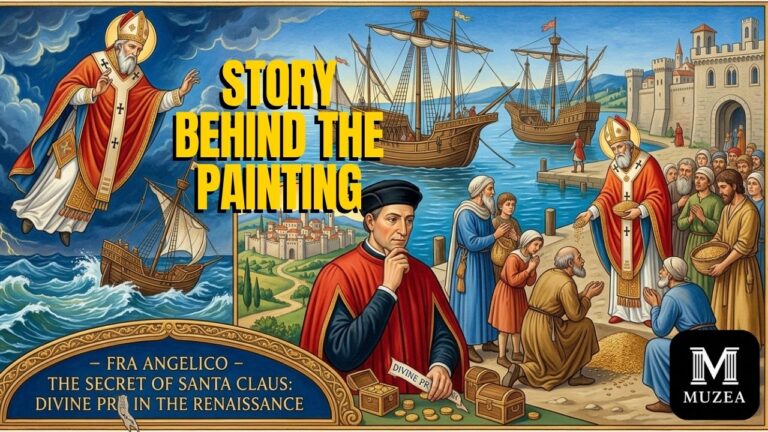
When we think of St. Nicholas today, the image that usually springs to mind is a jolly, white-bearded man in a red suit delivering toys in the dead of winter. But in the 15th century, “Santa Claus” looked quite different. He was a powerful, miracle-working fixer, a patron of merchants, and a spiritual “crisis manager.”

In the latest episode of Story Behind the Painting, we explore Fra Angelico’s 1437 masterpiece, St. Nicholas Saves the Ship. This work doesn’t just show us a saint; it reveals the complex intersection of faith, finance, and early Renaissance “influencer culture.”


From Bishop of Myra to Global Icon

Before he was a pop-culture legend, St. Nicholas was a 4th-century bishop in Myra (modern-day Turkey) [02:03]. While the “Golden Legend”—the medieval collection of saintly lives—is full of embellishments, the historical core of Nicholas is real.

The gift-giving tradition we associate with Christmas began with a story of Nicholas secretly providing bags of gold to a poor man to save his daughters from a life of destitution [02:35]. As the episode explains, this figure eventually evolved into Sinterklaas in the Netherlands and was brought to the New World by Dutch settlers, eventually merging into the modern Santa Claus we know today [02:42].

The Miracle of the Grain Ship

Fra Angelico’s painting, commissioned as a predella panel for an altarpiece in Perugia, depicts a different side of the saint [03:37]. Instead of toys, Nicholas is dealing with a grain ship during a famine.

The painting uses a technique called continuous narrative [03:53]. In a single frame, we see multiple moments of time:

  • A dramatic storm where the saint intervenes to save the vessel.

  • The calm harbor where the grain is safely distributed to a starving population.

By merging these moments, Fra Angelico highlights Nicholas’s role as a protector of the vulnerable—specifically sailors, merchants, and bankers who faced the treacherous risks of the 15th-century economy [01:22].

The “Selfie” of the 1400s: Cosimo de’ Medici

Perhaps the most intriguing detail in the painting is the presence of a figure in a prominent red cloak and black cap. Art historians believe this is none other than Cosimo de’ Medici, the de facto ruler of Florence and the head of the most powerful bank in Europe [04:40].

Why is a billionaire banker standing in a scene from the 4th century?

The episode draws a sharp modern parallel: it’s like a modern-day influencer filming themselves giving money to the poor to boost their image [05:02]. This was “Divine PR.” By placing himself next to St. Nicholas, Cosimo was linking his family’s immense wealth to divine favor. It served as a public statement to legitimize his financial practices and signal his piety to the masses [05:11].

A Touch of the Surreal

While Fra Angelico is known for his luminous colors and profound spirituality, the episode notes that this painting has a surprisingly “surreal” quality [06:11]. Because it presents multiple timelines and scales in one space—with realistic ships alongside a fantastical sea monster and an ethereal hovering saint—it evokes a dreamlike quality that predates the surrealist movement by centuries [06:20].

Fra Angelico was a Dominican friar who bridged the gap between the late Gothic style and the emerging Renaissance [05:51]. In this panel, he managed to capture both the mystical power of faith and the very grounded, political realities of his patrons.

Conclusion

St. Nicholas’s journey from a Turkish bishop to a Dutch folk hero to a global commercial icon is one of history’s most fascinating cultural evolutions. Fra Angelico’s St. Nicholas Saves the Ship reminds us that before the reindeer and the chimney, he was the saint you called when your ship was sinking—literally and financially.


Want to dive deeper into the world of art? Download the MUZEA app on the App Store or Google Play to explore more stories behind the world’s most famous paintings.

Watch the full episode here:

Verified by MonsterInsights