Tag

Medici Family

Browsing

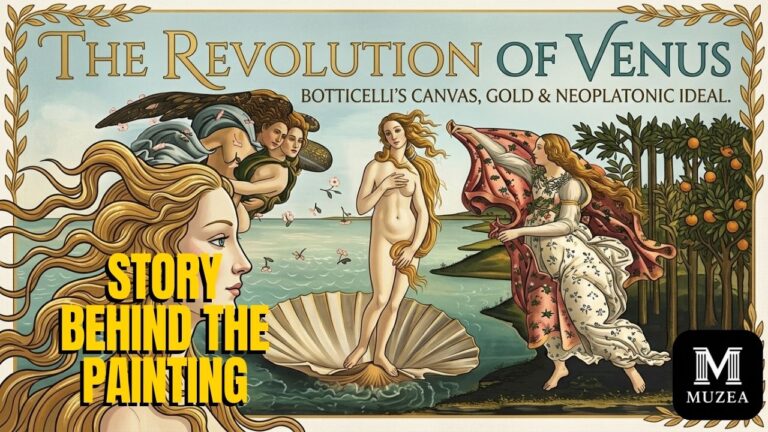
In the hallowed, sun-drenched halls of the Uffizi Gallery in Florence, one painting stands as the undisputed crown jewel of the collection. It is an image so ubiquitous it has graced everything from postcards to high-fashion runways, yet its mystery remains as deep as the sea from which its subject emerged. We are, of course, looking at Sandro Botticelli’s The Birth of Venus.

Created around 1485 to 1486, this masterpiece was more than just a beautiful decoration for a Medici villa; it was a revolution. For the first time in over a millennium, a large-scale non-religious nude was produced in Europe, signaling the dawn of a new humanistic era [00:35].

The Radical Choice of Canvas

To understand the brilliance of The Birth of Venus, we must first look at its “bones.” In the 1480s, high art in Florence was almost exclusively painted on heavy, rigid poplar wood panels. However, Botticelli made a radical, modern choice: he chose canvas [01:41].

While canvas is standard today, in the 15th century, it was a practical and aesthetic gamble. Destined for a Medici country villa, canvas was lighter, cheaper, and could be rolled up for transport [02:02]. But there was an artistic genius to this choice as well. Unlike the glass-like finish of sanded wood, the subtle “tooth” of the fabric breaks up the light, giving Venus’s skin a soft, matte quality—a velvet-like luminescence that wood simply cannot replicate [02:19].

A Goldsmith’s Precision

Botticelli was a trained goldsmith before he was a painter, and that background permeates every inch of the work. He used tempera grassa—pigments bound with egg yolk and a touch of oil—allowing him to paint with microscopic precision [02:37]. If you look closely, you won’t see broad, blended brushstrokes; instead, you’ll see thousands of tiny hatched lines building up the skin tones layer by layer [02:46].

To elevate the work to a divine status, Botticelli incorporated precious materials:

  • Lapis Lazuli: This semi-precious stone, brought all the way from Afghanistan, was crushed to create the deep blues of the sea and the cornflowers [03:14].

  • Gold Leaf: Botticelli touched the highlights of the hair, the wings of the winds, and even the trunks of the orange trees with actual gold [03:33]. Imagine this painting five centuries ago, flickering by candlelight in a dark villa; those gold accents would have made Venus appear as if she were radiating from within the canvas [03:49].

The Geometry of Grace

As you settle into the beauty of the figure, you might notice that her proportions are otherworldly. Her neck is impossibly long, and her left shoulder slopes at a steep, unnatural angle [04:07]. These are not errors. Botticelli wasn’t interested in the heavy scientific realism that obsessed his peers, such as Leonardo da Vinci. Instead, he was chasing a higher truth: perfect grace [04:44].

Influenced by the flowing curves of Gothic art, he distorted her body to remove her from our world. She is the “Celestial Venus,” an idea of beauty so pure it is weightless. She doesn’t even stand on the shell; she floats just above it [05:12].

A Divine Theater: The Scene on the Shore

The painting depicts the immediate aftermath of the birth of Venus from sea foam, as told by the Greek poet Hesiod. The composition is a lyrical movement of three distinct groups:

  1. The Winds (Zephyrus and Chloris): On the left, Zephyrus, the god of the west wind, exhales the air that drives Venus toward the shore. He is locked in a passionate embrace with the nymph Chloris, representing the fertilizing power of nature [06:25].

  2. Venus: In the center, she stands in a Venus Pudica (modest Venus) pose. Her gaze is distant and melancholic, treated with a marble-like finish that suggests a statue come to life [07:51].

  3. The Hora of Spring: On the right, a female figure rushes forward to clothe the goddess in a magnificent pink cloak decorated with daisies and primroses [08:27]. This act symbolizes the transition from the wild, raw state of nature into the ordered, cultured world of human civilization [09:27].

The Medici and the Neoplatonic Ideal

Why would a deeply Christian society like 15th-century Florence celebrate a pagan goddess in such a monumental way? The answer lies in Neoplatonism, the intellectual heartbeat of the Medici circle [11:34].

Led by thinkers like Marsilio Ficino, Neoplatonists believed that physical beauty was a “ladder” to the divine. By contemplating perfect beauty, the human soul could be reminded of God. In this light, Venus is an allegory for the soul being born into the world and purified by the spirit [11:55].

The orange grove in the background—the Medica Mala—was a direct visual pun on the name of the Medici family, who commissioned the work to project their status as the ultimate “New Men”: intellectuals comfortable with both the Christian cross and the ancient Greek gods [13:03].

Survival Against the Flames

The golden era of the Medici eventually fractured. Later in life, Florence fell under the shadow of the radical monk Girolamo Savonarola, who preached against the “vanities” of the Renaissance. During the infamous Bonfire of the Vanities in 1497, thousands of “sinful” objects were burned. Legend says Botticelli, swept up in the religious fervor, cast some of his own mythological paintings into the fire [15:38].

By a miracle of history—likely because it was hidden away in the safety of a country villa—The Birth of Venus survived [15:57].

A Legacy of Light

Sandro Botticelli’s true contribution was elevating secular storytelling to the same spiritual height as the biblical. He proved that a Greek myth could carry the same moral weight and divine beauty as a gospel scene [16:06].

The Birth of Venus remains a testament to the moment humanity decided to look back at the beauty of the ancients to find a way forward. It is a painting of movement, of wind, and of the eternal arrival of beauty [16:48].
When we think of St. Nicholas today, the image that usually springs to mind is a jolly, white-bearded man in a red suit delivering toys in the dead of winter. But in the 15th century, “Santa Claus” looked quite different. He was a powerful, miracle-working fixer, a patron of merchants, and a spiritual “crisis manager.”

In the latest episode of Story Behind the Painting, we explore Fra Angelico’s 1437 masterpiece, St. Nicholas Saves the Ship. This work doesn’t just show us a saint; it reveals the complex intersection of faith, finance, and early Renaissance “influencer culture.”


From Bishop of Myra to Global Icon

Before he was a pop-culture legend, St. Nicholas was a 4th-century bishop in Myra (modern-day Turkey) [02:03]. While the “Golden Legend”—the medieval collection of saintly lives—is full of embellishments, the historical core of Nicholas is real.

The gift-giving tradition we associate with Christmas began with a story of Nicholas secretly providing bags of gold to a poor man to save his daughters from a life of destitution [02:35]. As the episode explains, this figure eventually evolved into Sinterklaas in the Netherlands and was brought to the New World by Dutch settlers, eventually merging into the modern Santa Claus we know today [02:42].

The Miracle of the Grain Ship

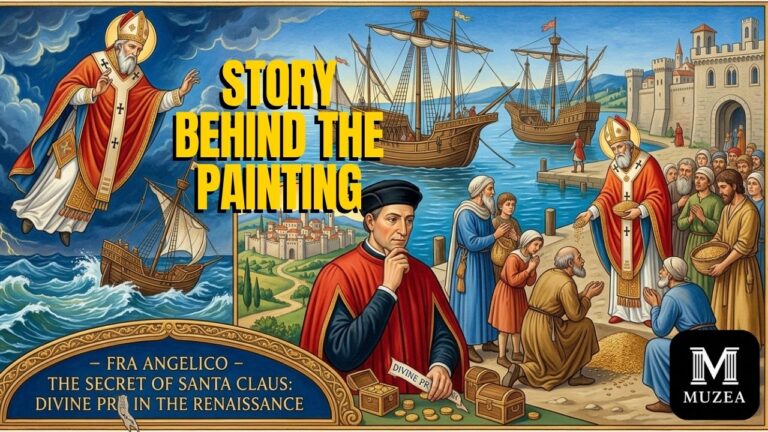
Fra Angelico’s painting, commissioned as a predella panel for an altarpiece in Perugia, depicts a different side of the saint [03:37]. Instead of toys, Nicholas is dealing with a grain ship during a famine.

The painting uses a technique called continuous narrative [03:53]. In a single frame, we see multiple moments of time:

  • A dramatic storm where the saint intervenes to save the vessel.

  • The calm harbor where the grain is safely distributed to a starving population.

By merging these moments, Fra Angelico highlights Nicholas’s role as a protector of the vulnerable—specifically sailors, merchants, and bankers who faced the treacherous risks of the 15th-century economy [01:22].

The “Selfie” of the 1400s: Cosimo de’ Medici

Perhaps the most intriguing detail in the painting is the presence of a figure in a prominent red cloak and black cap. Art historians believe this is none other than Cosimo de’ Medici, the de facto ruler of Florence and the head of the most powerful bank in Europe [04:40].

Why is a billionaire banker standing in a scene from the 4th century?

The episode draws a sharp modern parallel: it’s like a modern-day influencer filming themselves giving money to the poor to boost their image [05:02]. This was “Divine PR.” By placing himself next to St. Nicholas, Cosimo was linking his family’s immense wealth to divine favor. It served as a public statement to legitimize his financial practices and signal his piety to the masses [05:11].

A Touch of the Surreal

While Fra Angelico is known for his luminous colors and profound spirituality, the episode notes that this painting has a surprisingly “surreal” quality [06:11]. Because it presents multiple timelines and scales in one space—with realistic ships alongside a fantastical sea monster and an ethereal hovering saint—it evokes a dreamlike quality that predates the surrealist movement by centuries [06:20].

Fra Angelico was a Dominican friar who bridged the gap between the late Gothic style and the emerging Renaissance [05:51]. In this panel, he managed to capture both the mystical power of faith and the very grounded, political realities of his patrons.

Conclusion

St. Nicholas’s journey from a Turkish bishop to a Dutch folk hero to a global commercial icon is one of history’s most fascinating cultural evolutions. Fra Angelico’s St. Nicholas Saves the Ship reminds us that before the reindeer and the chimney, he was the saint you called when your ship was sinking—literally and financially.


Want to dive deeper into the world of art? Download the MUZEA app on the App Store or Google Play to explore more stories behind the world’s most famous paintings.

Watch the full episode here:

Imagine a 15th-century masterpiece that feels less like a static image and more like an action movie—horses rearing, lances breaking, and soldiers thrown backward in mid-air. Welcome to the world of Paolo Uccello’s The Battle of San Romano.

In the fourth episode of Story Behind the Painting, we explore how a relatively small skirmish in 1432 between Florence and Lucca became one of the most famous examples of propaganda, mathematics, and “ceremonial war” in the history of the Italian Renaissance.


A Triptych Divided Across Europe

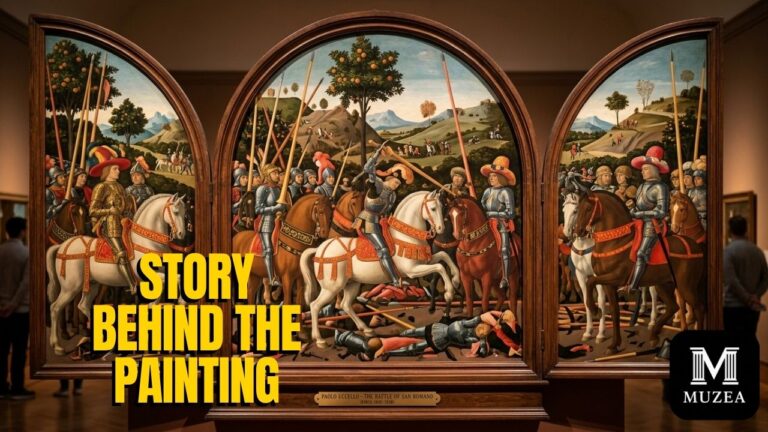
Today, the Battle of San Romano is a massive work composed of three separate panels. Interestingly, you have to travel across Europe to see the full story:

  • The Dawn (The London Panel): Housed in the National Gallery, London [07:07].

  • The Heat of Battle (The Florence Panel): Located in the Galleria degli Uffizi, Florence [09:29].

  • The Counterattack (The Paris Panel): Found in the Musée du Louvre, Paris [10:41].

500 years ago, however, these panels hung together in the Medici Palace. In fact, Lorenzo de’ Medici loved the paintings so much that he “forcibly moved” them from the Bartolini family villa to his own palace to use them as a ultimate power “flex” [01:51].


The Business of “Bloodless” War

To understand this painting, you have to understand 15th-century Italy. It wasn’t a unified country but a patchwork of wealthy kingdoms that hired private mercenary armies known as Condottieri [04:12].

War was a business, and these “War CEOs” were expensive assets. As a result, battles were often surprisingly bloodless. Mercenaries avoided killing each other because a dead opponent meant the war (and the paycheck) ended [06:04]. Machiavelli famously mocked these conflicts, saying they began without fear and ended without losses [05:48]. Uccello’s painting reflects this: the scene is clean, filled with gold leaf and bright colors, and remarkably free of blood [05:23].

Act I: The Dawn of the Red Hat

The London panel introduces our protagonist, Niccolò da Tolentino [07:17]. You can’t miss him—he’s wearing a massive, bright red and gold velvet hat called a mazzocchio.

While completely impractical for a real fight, the hat serves as a mythological “flex.” It shows Niccolò not just as a soldier, but as an emblematic, visionary leader. In the background, you can see two knights riding away from the center of the fray; they are messengers sent to notify allies that Niccolò is being outnumbered and needs a counterattack [09:12].

Act II: The Unseating of the Enemy

In the Florence panel, we see the turning point of the battle. The Sienese commander, Bernardino della Carda, is literally being unseated from his horse by a Florentine lance [09:37]. Uccello uses this panel to “stack” the scene, showing Florentine soldiers beginning to surround the enemy behind hills and in the distance.

Act III: The Arrival of the Cavalry

The final act in Paris shows the decisive counterattack led by Micheletto Attendolo [10:49]. Having received the message from the first panel, Micheletto arrives just in time to hit the Sienese flank. Once he arrived, the “math” of the battle changed, and the Sienese forces accepted defeat [11:39].


A Revolution in Mathematics: The Persistence of Perspective

While the battle was about propaganda, the execution of the painting was about a revolution in mathematics. Paolo Uccello was obsessed with linear perspective [00:43].

In the London panel, look at the broken lances on the ground. They aren’t scattered randomly; they are meticulously aligned to point toward a vanishing point, creating a radical sense of depth and three-dimensionality [12:05].

Uccello was also a master of foreshortening—painting objects (like the fallen soldier in the bottom left) at an angle to show depth [13:53]. To Uccello, battle was a mess, but geometry was order. By applying these strict rules, he turned a chaotic skirmish into an aesthetically pleasing, eternal stage.

The Medici Mark

When the paintings were moved to the Medici Palace, they had to be altered to fit the walls. The tops were cut, and the Medici added their own family symbol to the landscape: oranges [14:33]. In the 15th century, owning fresh oranges was the equivalent of owning a supercar today—a final, fruity layer of propaganda on an already legendary work.


Watch the full analysis here:

Verified by MonsterInsights