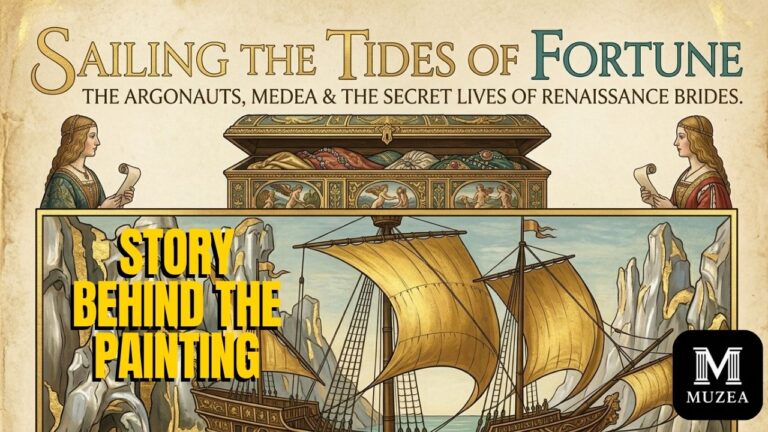
Imagine the year is 1491 in Ferrara, Italy. The air is thick with the scent of incense and expensive leather as a grand procession winds through cobblestone streets. At the center of the spectacle are two massive, ornate wooden chests gleaming with gold leaf: the cassoni, or bridal chests, of the legendary Este sisters, Isabella and Beatrice.
While these chests held the brides’ dowries, their exteriors offered a vision of another world. In episode 13 of The Story Behind the Painting, we step aboard the Argo with the masterpiece The Ship of the Argonauts, a collaborative work by the Ferrarese masters Ercole de’ Roberti and Lorenzo Costa.
A Hallucination on Oak
At first glance, The Ship of the Argonauts (painted around 1490-1491) feels like a hallucination. Measuring just 46 x 53 cm and painted on solid oak, it serves as a small window into a massive, surreal universe [01:15].
The Argo itself is a dark, imposing mass of wood and rigging, but the water beneath it is what truly strikes the viewer. Instead of the deep Mediterranean blues, Ercole de’ Roberti gives us a milky, white-green sea. The ship doesn’t seem to cut through waves; it feels suspended in a dreamlike void [01:34].
The landscape is equally bizarre. Rather than the soft rolling hills of Florence or Rome, we see jagged, pale cliffs—rock formations that tower over the crew like frozen waves of stone [02:10]. This is the signature of the Ferrara School: a mixture of the fantastic and the real, suggesting that the Argonauts have traveled to the very edge of the known world where the laws of nature begin to bend [02:18].
A Crew of Renaissance Superheroes
A ship is nothing without its crew, and the deck of the Argo serves as a stage for the greatest superheroes of antiquity. Among the fifty heroes on board, a few stand out:
-
Heracles (Hercules): Positioned toward the stern, he is a man of superhuman strength, stripped to the waist with a massive club and a lion’s skin draped over his shoulder [03:17].
-
Hylas: Beside Heracles stands his loyal arms-bearer, wielding a club of his own [03:31].
-
Jason: At the front of the vessel stands the captain, son of King Aeson, who built the largest ship the world had ever seen to fetch the Golden Fleece from the distant land of Colchis [04:16].
Each figure is elegantly elongated—a hallmark of the Ferrarese style—making them look less like mortal sailors and more like celestial beings [04:00].
The Secret Life of Bridal Chests
To truly understand this painting, you must view it as a piece of furniture. In 15th-century Italy, a high-status woman didn’t just pack a suitcase for her wedding; she had cassoni [05:09]. These were massive, expensive chests that held linens and jewels but also served a symbolic purpose in the marital bedroom.
Originally plain wood, these chests became masterpieces by the time Ercole de’ Roberti was active. But why depict the Argonauts on a bridal chest?
-
Didactic Lessons: These chests were meant to teach the bride how to behave. While some showed steadfast role models, the story of the Argonauts was more complex. It often included the tragedy of Medea, the sorceress who helped Jason but eventually murdered her own children, serving as a stern warning against unchecked emotion [06:05].
-
Political Branding: Ferrara was ruled by the Este family, a dynasty obsessed with the idea of “Fortune.” The image of a ship sailing before a strong wind was their personal impresa (symbolic device) [08:02]. It represented the “taste for risk” that defined the Renaissance spirit, whether navigating Italian politics or the literal waters of the Po River [06:34].
The Masters of the Ferrara School
The primary genius behind the work was Ercole de’ Roberti, the official court painter to the House of Este [09:14]. Because a set of bridal chests could include over a dozen panels, Ercole utilized an assistant, the younger Lorenzo Costa.
Art historians can distinguish their hands: the stronger panels with intense emotional energy and complex anatomy are Ercole’s, while the simpler panels were likely handled by Costa [09:42].
The Ferrara School rejected the “polite” softness of Florentine masters like Botticelli. Instead, they developed a style that was hard, nervous, and metallic [10:43]. Ercole de’ Roberti took new discoveries like linear perspective and twisted them to create fantastic, alien-like landscapes rather than realistic ones [10:59].
A Legacy of Risk
Ercole de’ Roberti didn’t just paint a ship; he captured the soul of the Renaissance—an era brave enough to stare into the bizarre and the unknown and call it beautiful. He proved that even everyday domestic objects could be vessels for the most profound stories of human resilience.
Whether you are a hero of myth or a young bride starting a new life, the Argo remains a reminder of the Ferrarrese war cry: Vela—Sail [11:45].
Check here the full episode: