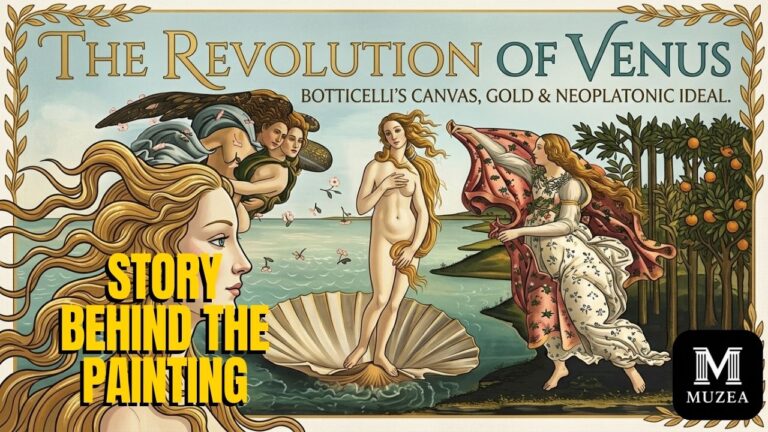
In the hallowed, sun-drenched halls of the Uffizi Gallery in Florence, one painting stands as the undisputed crown jewel of the collection. It is an image so ubiquitous it has graced everything from postcards to high-fashion runways, yet its mystery remains as deep as the sea from which its subject emerged. We are, of course, looking at Sandro Botticelli’s The Birth of Venus.
Created around 1485 to 1486, this masterpiece was more than just a beautiful decoration for a Medici villa; it was a revolution. For the first time in over a millennium, a large-scale non-religious nude was produced in Europe, signaling the dawn of a new humanistic era [00:35].
The Radical Choice of Canvas
To understand the brilliance of The Birth of Venus, we must first look at its “bones.” In the 1480s, high art in Florence was almost exclusively painted on heavy, rigid poplar wood panels. However, Botticelli made a radical, modern choice: he chose canvas [01:41].
While canvas is standard today, in the 15th century, it was a practical and aesthetic gamble. Destined for a Medici country villa, canvas was lighter, cheaper, and could be rolled up for transport [02:02]. But there was an artistic genius to this choice as well. Unlike the glass-like finish of sanded wood, the subtle “tooth” of the fabric breaks up the light, giving Venus’s skin a soft, matte quality—a velvet-like luminescence that wood simply cannot replicate [02:19].
A Goldsmith’s Precision
Botticelli was a trained goldsmith before he was a painter, and that background permeates every inch of the work. He used tempera grassa—pigments bound with egg yolk and a touch of oil—allowing him to paint with microscopic precision [02:37]. If you look closely, you won’t see broad, blended brushstrokes; instead, you’ll see thousands of tiny hatched lines building up the skin tones layer by layer [02:46].
To elevate the work to a divine status, Botticelli incorporated precious materials:
-
Lapis Lazuli: This semi-precious stone, brought all the way from Afghanistan, was crushed to create the deep blues of the sea and the cornflowers [03:14].
-
Gold Leaf: Botticelli touched the highlights of the hair, the wings of the winds, and even the trunks of the orange trees with actual gold [03:33]. Imagine this painting five centuries ago, flickering by candlelight in a dark villa; those gold accents would have made Venus appear as if she were radiating from within the canvas [03:49].
The Geometry of Grace
As you settle into the beauty of the figure, you might notice that her proportions are otherworldly. Her neck is impossibly long, and her left shoulder slopes at a steep, unnatural angle [04:07]. These are not errors. Botticelli wasn’t interested in the heavy scientific realism that obsessed his peers, such as Leonardo da Vinci. Instead, he was chasing a higher truth: perfect grace [04:44].
Influenced by the flowing curves of Gothic art, he distorted her body to remove her from our world. She is the “Celestial Venus,” an idea of beauty so pure it is weightless. She doesn’t even stand on the shell; she floats just above it [05:12].
A Divine Theater: The Scene on the Shore
The painting depicts the immediate aftermath of the birth of Venus from sea foam, as told by the Greek poet Hesiod. The composition is a lyrical movement of three distinct groups:
-
The Winds (Zephyrus and Chloris): On the left, Zephyrus, the god of the west wind, exhales the air that drives Venus toward the shore. He is locked in a passionate embrace with the nymph Chloris, representing the fertilizing power of nature [06:25].
-
Venus: In the center, she stands in a Venus Pudica (modest Venus) pose. Her gaze is distant and melancholic, treated with a marble-like finish that suggests a statue come to life [07:51].
-
The Hora of Spring: On the right, a female figure rushes forward to clothe the goddess in a magnificent pink cloak decorated with daisies and primroses [08:27]. This act symbolizes the transition from the wild, raw state of nature into the ordered, cultured world of human civilization [09:27].
The Medici and the Neoplatonic Ideal
Why would a deeply Christian society like 15th-century Florence celebrate a pagan goddess in such a monumental way? The answer lies in Neoplatonism, the intellectual heartbeat of the Medici circle [11:34].
Led by thinkers like Marsilio Ficino, Neoplatonists believed that physical beauty was a “ladder” to the divine. By contemplating perfect beauty, the human soul could be reminded of God. In this light, Venus is an allegory for the soul being born into the world and purified by the spirit [11:55].
The orange grove in the background—the Medica Mala—was a direct visual pun on the name of the Medici family, who commissioned the work to project their status as the ultimate “New Men”: intellectuals comfortable with both the Christian cross and the ancient Greek gods [13:03].
Survival Against the Flames
The golden era of the Medici eventually fractured. Later in life, Florence fell under the shadow of the radical monk Girolamo Savonarola, who preached against the “vanities” of the Renaissance. During the infamous Bonfire of the Vanities in 1497, thousands of “sinful” objects were burned. Legend says Botticelli, swept up in the religious fervor, cast some of his own mythological paintings into the fire [15:38].
By a miracle of history—likely because it was hidden away in the safety of a country villa—The Birth of Venus survived [15:57].
A Legacy of Light
Sandro Botticelli’s true contribution was elevating secular storytelling to the same spiritual height as the biblical. He proved that a Greek myth could carry the same moral weight and divine beauty as a gospel scene [16:06].
The Birth of Venus remains a testament to the moment humanity decided to look back at the beauty of the ancients to find a way forward. It is a painting of movement, of wind, and of the eternal arrival of beauty [16:48].