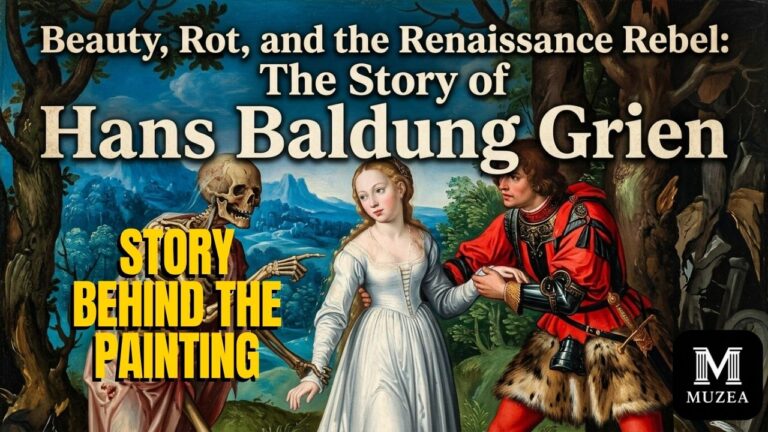
In the early 16th century, the art world was obsessed with perfection. While masters like Albrecht Dürer were busy mapping the divine proportions of the human body, a teenage rebel in his workshop was getting bored. That teenager was Hans Baldung, nicknamed “Grien” for his fixation on the color green, and he was about to drag the Renaissance’s obsession with beauty straight through a graveyard.
In the latest episode of The Story Behind the Painting, we dive into Baldung’s 1503 masterpiece, “The Knight, the Maiden, and Death.” Here is the breakdown of how this 18-year-old “wunderkind” changed the way we look at mortality.
1. Breaking the Rules of Perfection [01:03]
While Dürer focused on mathematical harmony, Baldung wanted to capture the “visceral, messy reality of being alive and being dead.” You can see his rebellious streak in the painting’s horse—its neck is too thick, and its movement is anatomically confusing.
Far from a lack of skill, this “equine fail” was a deliberate choice. Baldung wasn’t interested in a perfect horse; he wanted to capture the chaos of a world being pulled apart by a force that doesn’t care about correct proportions.
2. The Pioneer of Horror [02:35]
Baldung wasn’t just a painter; he was a technical revolutionary. He pioneered the Chiaroscuro woodcut, using multiple wood blocks to “carve light itself.” By utilizing the white of the paper for supernatural highlights, he created a visual language for witchcraft and horror that we still recognize today. He proved that art didn’t have to be perfect to be powerful—it just had to be bold enough to look into the shadows.
3. A Physical Reality of Decay [03:10]
In 1503, the plague was a constant, terrifying neighbor. Because of this, Baldung’s “Death” isn’t a clean, symbolic skeleton. It is a harrowing, “living remnant” with shriveled, translucent skin clinging to its frame like aged parchment [03:23].
He leaned into the erotic macabre, pairing peak human vitality with worm-eaten decay. It was a reminder that death isn’t just a metaphor or a ghost; it’s a physical transformation that claims the flesh.
4. The Tug-of-War: Blue, Red, and Bone [05:35]
The painting is a visual battleground divided by color:
-
Blue: Seen in the lush landscape, representing fidelity, the heavens, and the aristocracy [05:41].
-
Red: The knight’s outfit, representing passion, blood, and danger. In the 1500s, only high nobility could wear such vibrant red [05:49].
-
The Contrast: Despite the knight’s silk shirts and fur-trimmed skirts—the peak of earthly vanity—Death is literally pulling him off his horse [06:15].
5. Memento Mori vs. Memento Vivere [06:21]
The painting sits on the fence between two eras:
-
Middle Ages (Memento Mori): “Remember you must die.” A command to ignore the world and focus on the soul.
-
Renaissance (Memento Vivere): “Remember you are alive.”
Baldung uses the unblemished beauty of the maiden to create a jarring contrast with the eviscerated figure of Death [06:41]. He isn’t telling us to ignore the world; he is telling us that the beauty of life is heightened because it is so fragile.
Conclusion
Hans Baldung Grien became the darker side of the Northern Renaissance. He looked into the shadows that Dürer tried to illuminate, declaring that while life is a fleeting race, the finish line is always made of bone.
Watch the full analysis here: