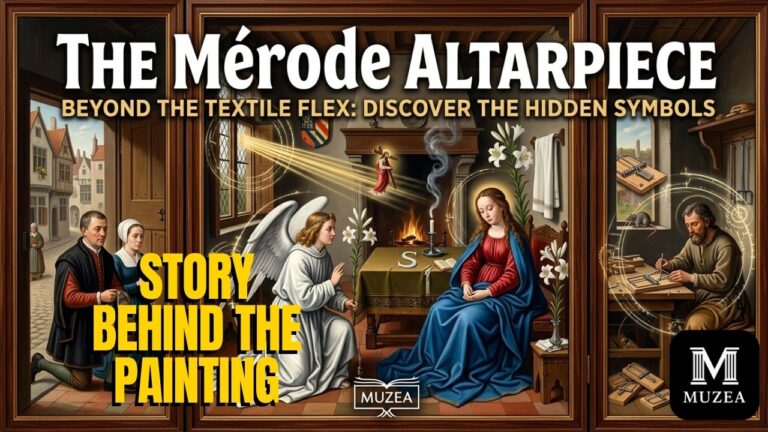
In the modern world, we “flex” our success through designer clothes, high-end smartphones, or luxury travel. In the 15th century, however, the ultimate status symbol wasn’t a car—it was a commissioned painting. But as the latest episode of Story Behind the Painting reveals, the Mérode Altarpiece (or the Annunciation Triptych) by Robert Campin was more than just a display of wealth; it was a complex blend of marketing, domestic prayer, and revolutionary artistic detail.
The Ultimate Textile Flex
Unlike most grand altarpieces of the era, this work wasn’t commissioned by a priest for a cathedral. Instead, it was paid for by a wealthy merchant, likely from the Inghelbrecht family (identified by the coat of arms in the window) [01:39].
Because the client made his fortune in textiles, the painting is essentially a high-end advertisement for his business. Look closely at the robes of the Angel Gabriel and the Virgin Mary—the fabric is heavy, voluminous, and folded with such precision that it dominates the frame. By showcasing such “finesse” in the rendering of cloth, the merchant was subtly promoting the quality of his own wares [01:20].
A Home for the Holy
The Mérode Altarpiece was designed as a home altar. Measuring roughly two feet tall, it was intended for private devotion in a middle-class Dutch home [01:54]. The owners would kneel before it to pray to Mary, often asking for the blessing of children.
What makes this painting a masterpiece of the Northern Renaissance is its setting. While Italian artists were obsessed with the idealized human body and mathematical perspective, Northern artists like Campin focused on hyper-realistic textures and domestic interiors. Through the use of oil paint, Campin captured:
-
The rust on iron nails [03:30].
-
The delicate feathers of an angel’s wings.
-
Double shadows cast on the walls, suggesting two light sources—the window and the open door—a level of “ray tracing” that was centuries ahead of its time [05:41].
Hidden Symbols in Every Corner
The central panel depicts the Annunciation—the moment Gabriel tells Mary she will bear the Son of God. But Campin strips away the traditional golden halos to make the figures feel more human and accessible [05:07]. Instead, holiness is signaled through everyday objects:
-
The Tiny Jesus: Look for a small figure carrying a cross flying through the window on seven beams of light [05:25].
-
Purity Symbols: The white lilies, the clean white towel, and the polished water pot all represent Mary’s virginity.
-
The Extinguished Candle: A thin wisp of smoke rises from a candle that was just blown out. Some suggest this represents the moment the Divine enters the physical world, 혹은 perhaps a draft from the open door [06:08].
Joseph and the Mouse Traps
The right panel features Joseph in his workshop, and it contains one of the most famous “Easter eggs” in art history: mouse traps [06:54]. One sits on his workbench, and another is displayed on the window ledge outside.
While some theologians argue the trap symbolizes Christ as the “bait” to catch the devil, there’s a more practical theory related to the time. The 15th century was still reeling from the Black Plague, which people knew was carried by rats. By showing Joseph making mouse traps, the painting portrays him as a provider and a protector—keeping the home safe from both physical disease and spiritual evil [07:37].
The World Outside the Window
While the interior feels peaceful, the world outside was anything but. The 15th century was defined by the Hundred Years’ War, English occupations, and civil unrest in cities like Paris and Ghent [02:46]. This painting offers a rare, idealized glimpse of peaceful Dutch streets, contrasting the chaos of the era with the eternal calm of the divine [02:39].
A Modern Twist
The episode concludes with a playful “updated” version of the triptych created by AI. In this modern reimagining, the holy family lives in a cramped apartment (due to the housing crisis), Joseph is a software engineer protecting the home from cyber attacks, and the angel Gabriel might have a hard time fitting through the small windows [09:46]!
Whether viewed in the 1400s or through a digital lens today, the Mérode Altarpiece remains a testament to the power of detail and the enduring intersection of the sacred and the mundane.
Watch the full analysis here: