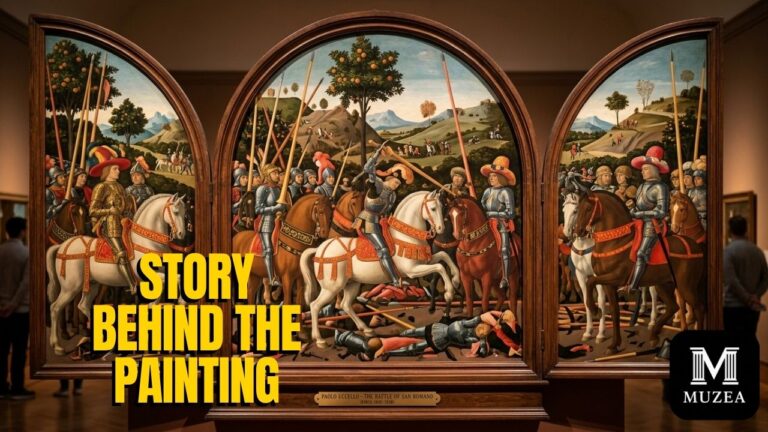
Imagine a 15th-century masterpiece that feels less like a static image and more like an action movie—horses rearing, lances breaking, and soldiers thrown backward in mid-air. Welcome to the world of Paolo Uccello’s The Battle of San Romano.
In the fourth episode of Story Behind the Painting, we explore how a relatively small skirmish in 1432 between Florence and Lucca became one of the most famous examples of propaganda, mathematics, and “ceremonial war” in the history of the Italian Renaissance.
A Triptych Divided Across Europe
Today, the Battle of San Romano is a massive work composed of three separate panels. Interestingly, you have to travel across Europe to see the full story:
-
The Dawn (The London Panel): Housed in the National Gallery, London [07:07].
-
The Heat of Battle (The Florence Panel): Located in the Galleria degli Uffizi, Florence [09:29].
-
The Counterattack (The Paris Panel): Found in the Musée du Louvre, Paris [10:41].
500 years ago, however, these panels hung together in the Medici Palace. In fact, Lorenzo de’ Medici loved the paintings so much that he “forcibly moved” them from the Bartolini family villa to his own palace to use them as a ultimate power “flex” [01:51].
The Business of “Bloodless” War
To understand this painting, you have to understand 15th-century Italy. It wasn’t a unified country but a patchwork of wealthy kingdoms that hired private mercenary armies known as Condottieri [04:12].
War was a business, and these “War CEOs” were expensive assets. As a result, battles were often surprisingly bloodless. Mercenaries avoided killing each other because a dead opponent meant the war (and the paycheck) ended [06:04]. Machiavelli famously mocked these conflicts, saying they began without fear and ended without losses [05:48]. Uccello’s painting reflects this: the scene is clean, filled with gold leaf and bright colors, and remarkably free of blood [05:23].
Act I: The Dawn of the Red Hat
The London panel introduces our protagonist, Niccolò da Tolentino [07:17]. You can’t miss him—he’s wearing a massive, bright red and gold velvet hat called a mazzocchio.
While completely impractical for a real fight, the hat serves as a mythological “flex.” It shows Niccolò not just as a soldier, but as an emblematic, visionary leader. In the background, you can see two knights riding away from the center of the fray; they are messengers sent to notify allies that Niccolò is being outnumbered and needs a counterattack [09:12].
Act II: The Unseating of the Enemy
In the Florence panel, we see the turning point of the battle. The Sienese commander, Bernardino della Carda, is literally being unseated from his horse by a Florentine lance [09:37]. Uccello uses this panel to “stack” the scene, showing Florentine soldiers beginning to surround the enemy behind hills and in the distance.
Act III: The Arrival of the Cavalry
The final act in Paris shows the decisive counterattack led by Micheletto Attendolo [10:49]. Having received the message from the first panel, Micheletto arrives just in time to hit the Sienese flank. Once he arrived, the “math” of the battle changed, and the Sienese forces accepted defeat [11:39].
A Revolution in Mathematics: The Persistence of Perspective
While the battle was about propaganda, the execution of the painting was about a revolution in mathematics. Paolo Uccello was obsessed with linear perspective [00:43].
In the London panel, look at the broken lances on the ground. They aren’t scattered randomly; they are meticulously aligned to point toward a vanishing point, creating a radical sense of depth and three-dimensionality [12:05].
Uccello was also a master of foreshortening—painting objects (like the fallen soldier in the bottom left) at an angle to show depth [13:53]. To Uccello, battle was a mess, but geometry was order. By applying these strict rules, he turned a chaotic skirmish into an aesthetically pleasing, eternal stage.
The Medici Mark
When the paintings were moved to the Medici Palace, they had to be altered to fit the walls. The tops were cut, and the Medici added their own family symbol to the landscape: oranges [14:33]. In the 15th century, owning fresh oranges was the equivalent of owning a supercar today—a final, fruity layer of propaganda on an already legendary work.
Watch the full analysis here: