When we think of St. Nicholas today, the image that usually springs to mind is a jolly, white-bearded man in a red suit delivering toys in the dead of winter. But in the 15th century, “Santa Claus” looked quite different. He was a powerful, miracle-working fixer, a patron of merchants, and a spiritual “crisis manager.”
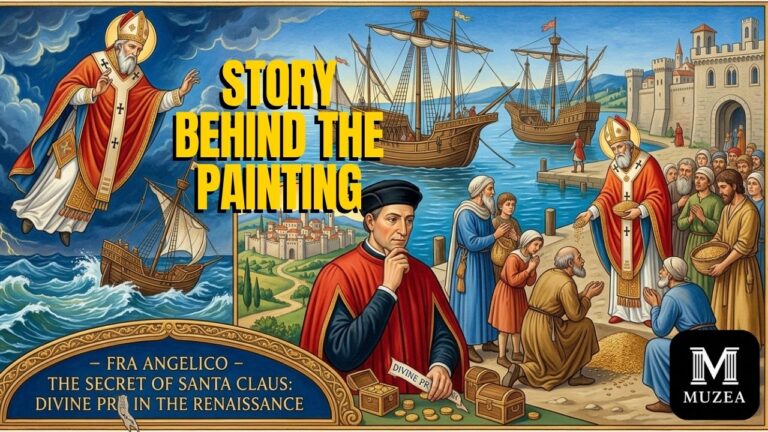
In the latest episode of Story Behind the Painting, we explore Fra Angelico’s 1437 masterpiece, St. Nicholas Saves the Ship. This work doesn’t just show us a saint; it reveals the complex intersection of faith, finance, and early Renaissance “influencer culture.”
From Bishop of Myra to Global Icon
Before he was a pop-culture legend, St. Nicholas was a 4th-century bishop in Myra (modern-day Turkey) [02:03]. While the “Golden Legend”—the medieval collection of saintly lives—is full of embellishments, the historical core of Nicholas is real.
The gift-giving tradition we associate with Christmas began with a story of Nicholas secretly providing bags of gold to a poor man to save his daughters from a life of destitution [02:35]. As the episode explains, this figure eventually evolved into Sinterklaas in the Netherlands and was brought to the New World by Dutch settlers, eventually merging into the modern Santa Claus we know today [02:42].
The Miracle of the Grain Ship
Fra Angelico’s painting, commissioned as a predella panel for an altarpiece in Perugia, depicts a different side of the saint [03:37]. Instead of toys, Nicholas is dealing with a grain ship during a famine.
The painting uses a technique called continuous narrative [03:53]. In a single frame, we see multiple moments of time:
-
A dramatic storm where the saint intervenes to save the vessel.
-
The calm harbor where the grain is safely distributed to a starving population.
By merging these moments, Fra Angelico highlights Nicholas’s role as a protector of the vulnerable—specifically sailors, merchants, and bankers who faced the treacherous risks of the 15th-century economy [01:22].
The “Selfie” of the 1400s: Cosimo de’ Medici
Perhaps the most intriguing detail in the painting is the presence of a figure in a prominent red cloak and black cap. Art historians believe this is none other than Cosimo de’ Medici, the de facto ruler of Florence and the head of the most powerful bank in Europe [04:40].
Why is a billionaire banker standing in a scene from the 4th century?
The episode draws a sharp modern parallel: it’s like a modern-day influencer filming themselves giving money to the poor to boost their image [05:02]. This was “Divine PR.” By placing himself next to St. Nicholas, Cosimo was linking his family’s immense wealth to divine favor. It served as a public statement to legitimize his financial practices and signal his piety to the masses [05:11].
A Touch of the Surreal
While Fra Angelico is known for his luminous colors and profound spirituality, the episode notes that this painting has a surprisingly “surreal” quality [06:11]. Because it presents multiple timelines and scales in one space—with realistic ships alongside a fantastical sea monster and an ethereal hovering saint—it evokes a dreamlike quality that predates the surrealist movement by centuries [06:20].
Fra Angelico was a Dominican friar who bridged the gap between the late Gothic style and the emerging Renaissance [05:51]. In this panel, he managed to capture both the mystical power of faith and the very grounded, political realities of his patrons.
Conclusion
St. Nicholas’s journey from a Turkish bishop to a Dutch folk hero to a global commercial icon is one of history’s most fascinating cultural evolutions. Fra Angelico’s St. Nicholas Saves the Ship reminds us that before the reindeer and the chimney, he was the saint you called when your ship was sinking—literally and financially.
Want to dive deeper into the world of art? Download the MUZEA app on the App Store or Google Play to explore more stories behind the world’s most famous paintings.
Watch the full episode here: