Tag

Art Education

Browsing

In the early 16th century, the art world was obsessed with perfection. While masters like Albrecht Dürer were busy mapping the divine proportions of the human body, a teenage rebel in his workshop was getting bored. That teenager was Hans Baldung, nicknamed “Grien” for his fixation on the color green, and he was about to drag the Renaissance’s obsession with beauty straight through a graveyard.

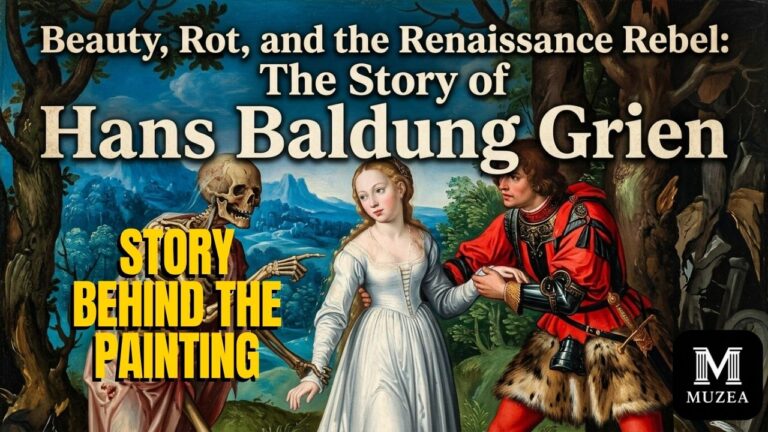
In the latest episode of The Story Behind the Painting, we dive into Baldung’s 1503 masterpiece, “The Knight, the Maiden, and Death.” Here is the breakdown of how this 18-year-old “wunderkind” changed the way we look at mortality.


1. Breaking the Rules of Perfection [01:03]

While Dürer focused on mathematical harmony, Baldung wanted to capture the “visceral, messy reality of being alive and being dead.” You can see his rebellious streak in the painting’s horse—its neck is too thick, and its movement is anatomically confusing.

Far from a lack of skill, this “equine fail” was a deliberate choice. Baldung wasn’t interested in a perfect horse; he wanted to capture the chaos of a world being pulled apart by a force that doesn’t care about correct proportions.

2. The Pioneer of Horror [02:35]

Baldung wasn’t just a painter; he was a technical revolutionary. He pioneered the Chiaroscuro woodcut, using multiple wood blocks to “carve light itself.” By utilizing the white of the paper for supernatural highlights, he created a visual language for witchcraft and horror that we still recognize today. He proved that art didn’t have to be perfect to be powerful—it just had to be bold enough to look into the shadows.

3. A Physical Reality of Decay [03:10]

In 1503, the plague was a constant, terrifying neighbor. Because of this, Baldung’s “Death” isn’t a clean, symbolic skeleton. It is a harrowing, “living remnant” with shriveled, translucent skin clinging to its frame like aged parchment [03:23].

He leaned into the erotic macabre, pairing peak human vitality with worm-eaten decay. It was a reminder that death isn’t just a metaphor or a ghost; it’s a physical transformation that claims the flesh.

4. The Tug-of-War: Blue, Red, and Bone [05:35]

The painting is a visual battleground divided by color:

  • Blue: Seen in the lush landscape, representing fidelity, the heavens, and the aristocracy [05:41].

  • Red: The knight’s outfit, representing passion, blood, and danger. In the 1500s, only high nobility could wear such vibrant red [05:49].

  • The Contrast: Despite the knight’s silk shirts and fur-trimmed skirts—the peak of earthly vanity—Death is literally pulling him off his horse [06:15].

5. Memento Mori vs. Memento Vivere [06:21]

The painting sits on the fence between two eras:

  • Middle Ages (Memento Mori): “Remember you must die.” A command to ignore the world and focus on the soul.

  • Renaissance (Memento Vivere): “Remember you are alive.”

Baldung uses the unblemished beauty of the maiden to create a jarring contrast with the eviscerated figure of Death [06:41]. He isn’t telling us to ignore the world; he is telling us that the beauty of life is heightened because it is so fragile.


Conclusion

Hans Baldung Grien became the darker side of the Northern Renaissance. He looked into the shadows that Dürer tried to illuminate, declaring that while life is a fleeting race, the finish line is always made of bone.

Watch the full analysis here:
In the bustling streets of 15th-century Florence, graduation didn’t involve a cap and gown. Instead, for the sons of wealthy merchants and bankers, the transition to adulthood was marked by a “journey of initiation.” It was a high-stakes business trip across bandit-filled forests and over the treacherous Alps to learn the family trade.

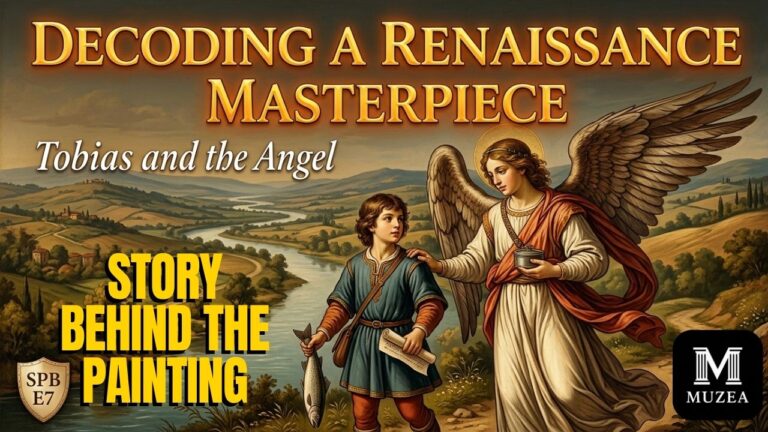
The latest episode of Story Behind the Painting by MUZEA takes us deep into a masterpiece that served as the “visual mascot” for these nervous fathers and ambitious sons: Tobias and the Angel (c. 1469), painted by the legendary brothers Antonio and Piero del Pollaiuolo.

More Than a Bible Story

At first glance, the painting depicts a scene from the Book of Tobit. Young Tobias is sent by his blind father to collect a debt in a distant city. But as the episode reveals, the Pollaiuolo brothers weren’t just retelling scripture; they were painting the lived reality of the Florentine elite [00:19].

Tobias represents the next generation of the merchant class. In his hand, he carries a small roll of parchment. In the 1400s, this wasn’t just a letter—it was a bill of exchange [01:23]. This “high-tech” financial tool allowed bankers to move vast sums of money across borders without carrying heavy, target-painting bags of gold. It was the Renaissance equivalent of a wire transfer.

The Ultimate Mentor: Archangel Raphael

The journey was dangerous, which is why Tobias isn’t alone. He is accompanied by the Archangel Raphael, often called the “Angel of Safe Conduct” [01:49].

The episode highlights a fascinating detail: the striking similarity between the faces of Tobias and the Angel. This suggests a “guardian twin” concept—the idea that every person has a heavenly double guiding them. Raphael is the ultimate mentor, the “heavenly double” of the young apprentice, providing divine protection as the boy navigates the “mission of trust” [02:19].

The Symbolism of the Fish and the Dog

Two animals play crucial roles in this composition:

  1. The Fish: Tobias carries a fish caught from the Tigris River [02:56]. While it literally refers to the source of the medicine needed to cure his father’s blindness, it also acts as a “code.” In mercantile culture, it was a symbol of validity, and spiritually, it represented Christ (via the Greek acrostic ichthus).

  2. The Dog: A small, fluffy dog trots ahead of the pair. In art history, the dog is the universal symbol of fidelity and loyalty [04:51]—essential traits for a young man trusted with the family’s wealth and reputation.

The “Power Duo” Behind the Canvas

The episode dives into the fascinating history of the artists, Antonio and Piero del Pollaiuolo. Interestingly, “Pollaiuolo” wasn’t their real last name; it was a nickname derived from their father’s job as a poultry seller (pollo meaning hen coop in Italian) [06:27].

While their father dealt in chickens, the brothers had much loftier ambitions. They became the “Silicon Valley” of their day, experimenting with revolutionary techniques:

  • The Oil Revolution: At a time when most Italian artists used flat, matte egg tempera, the Pollaiuolos were among the first to use translucent oil glazes [05:48]. This is why the fabrics in the painting—the crimson jackets, velvet, and silk—shimmer with such realistic depth.

  • Anatomical Outlaws: Legend has it the brothers were the first to perform human dissections [07:41]. They didn’t want to just paint a figure; they wanted to show the tension of skin over flexing muscle, a pursuit that would later influence Michelangelo.

  • The Cinematic Landscape: The background shows the Arno Valley with a high vantage point, giving the painting a “cinematic drone shot feel” that was revolutionary for the 1460s [08:20].

Why It Matters Today

The beauty of Tobias and the Angel lies in its humanity. As the narrator aptly puts it, the painting represents the universal bridge between childhood and adult responsibility [09:56].

Whether it’s a Florentine teenager in 1469 clutching a bill of exchange or a modern graduate heading to their first internship, the feeling remains the same: a mix of fear, excitement, and the search for a mentor to show the way. The Pollaiuolo brothers didn’t just paint a religious scene; they captured the weight of expectations and the hope of a safe return.


Watch the full breakdown here:


Verified by MonsterInsights