Tag

Art Analysis

Browsing

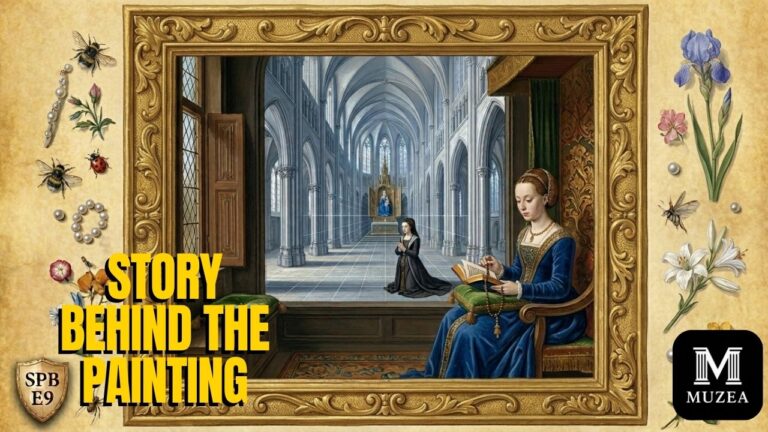
Imagine holding a device in the late 1470s that could transport you from a quiet, candlelit room into the soaring, silver-lit nave of a massive Gothic cathedral. It’s not a headset or a screen; it’s a book. Specifically, it’s the Hours of Mary of Burgundy, a masterpiece of Flemish illumination that the latest episode of Story Behind the Painting by MUZEA describes as the “virtual reality” of the 15th century.

The Window Miniature: A Visual Revolution

The centerpiece of this episode is the “window miniature,” a painting so advanced it feels like a trick of the eye—or more accurately, a trompe l’oeil [02:38].

The painting depicts a woman, Mary of Burgundy, sitting by a window and reading her prayer book. But as you look through that window, you see a second version of Mary, kneeling before the Virgin and Child inside a cathedral [02:22]. This is “simultaneous reality” [03:32]:

  • The Physical Mary: Sits in the “now,” touching her prayer beads and reading.

  • The Spiritual Mary: Exists inside the sacred vision she is reading about.

The artist uses linear perspective to pull the viewer’s eye into the depths of the cathedral, creating a sense of infinite space on a piece of vellum smaller than a standard iPad screen [01:49]. By treating the page’s edge as a physical windowsill, the artist turns flat parchment into a three-dimensional portal.

The Woman Behind the Book: The Most Sought-After Bachelorette

Mary of Burgundy was far from a fragile princess. At just 20 years old, she became the Duchess of Burgundy after her father, Charles the Bold, was killed in battle [05:02]. At the time, Burgundy was a “middle kingdom” stretching from Switzerland to the North Sea, controlling trade and cloth production—making it the wealthiest court in Europe [04:16].

Mary faced immense pressure from King Louis XI of France (known as the “Universal Spider” for his webs of lies), who tried to seize her lands and force her into marriage [05:17]. Amidst this chaos, this prayer book served as her private sanctuary.

Interestingly, Mary was also a vibrant athlete. She was a master of falconry, an expert equestrian, and loved ice skating on the frozen canals of Flanders [06:06]. Tragically, it was her love of the outdoors that led to her end; she died at just 25 after a horse-riding accident during a falcon hunt [06:41].

The Anonymous Master: The “Banksy” of the 1470s

The genius behind this work remains a mystery. Known only as the Vienna Master of Mary of Burgundy, this anonymous Flemish illuminator was a revolutionary [07:22].

Before his influence, medieval book illustrations were beautiful but flat. The Master introduced:

  1. Trompe l’oeil Borders: He painted jewelry, glass vases, and flowers with realistic shadows so they appeared to sit on top of the page [08:05].

  2. Atmospheric Perspective: He showed how light and air make distant objects paler and less sharp, as seen in the cool, silver light of the cathedral interior [08:22].

  3. Introspective Emotion: Unlike the stiff symbols of previous eras, Mary’s face shows a quiet, pensive depth—a human soul in a moment of private reflection [08:40].

A Legacy of Light and Space

The Master of Mary of Burgundy was the founder of the Gent-Bruges School, the foremost center for manuscript illumination in Europe [09:01]. His techniques paved the way for the grand landscape paintings of the High Renaissance. Without his “window concept,” the shift from symbolic medieval art to the realistic perspective of the Renaissance might have looked very different.

When you look at this miniature, you aren’t just looking at a Duchess; you are looking at the ghost of a woman who was brave, athletic, and visionary, frozen forever in a moment where the material world ends and the divine imagination begins [04:07].


Explore the miniature in detail:
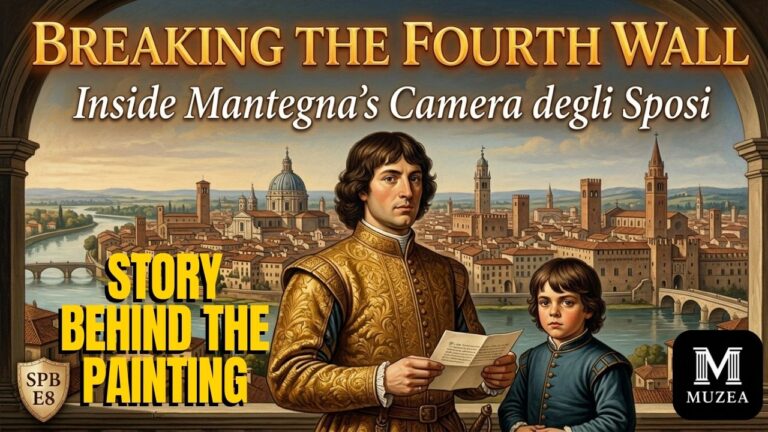
In the grand tapestry of the Italian Renaissance, few rooms hold as much mystery, power, and technical wizardry as the Camera degli Sposi (Room of the Newlyweds) in Mantua’s Palazzo Ducale. Completed in 1474 by the master Andrea Mantegna, this space isn’t just a decorated room—it is a nine-year labor of love that fundamentally changed the trajectory of Western art.

The latest episode of Story Behind the Painting by MUZEA takes us inside this “painted cube,” revealing the secrets of the Gonzaga family and the man who learned to “carve” with a paintbrush.

A Room of Paradoxes

Located in the northeast tower of the Castel San Giorgio, the Camera degli Sposi (also known as the Camera Picta or “Painted Room”) is a near-perfect cube, measuring roughly 8.1 meters on each side [02:34].

While the room’s name suggests a private bridal chamber, its function was far more public. It served as a high-stakes reception space where Ludovico III Gonzaga, the Marquis of Mantua, met with ambassadors and rivals. In a world where Mantua was a “small, swampy Marquisite” lacking the banking power of Florence or the agricultural vastness of the South, Ludovico used this room as a form of “soft power” [08:42]. By commissioning the most technologically advanced room in Europe, he signaled that he was a man of supreme intellect and Roman-style authority [09:10].

The Snapshot of Power: The Court Scene

On the north wall, Mantegna captures the Gonzaga family not in a stiff, formal pose, but in a living “snapshot.” Ludovico is seated, turning toward his secretary who whispers a message or hands him a letter [05:38].

History suggests this letter might have been the moment Ludovico learned his ally, the Duke of Milan, was dying—a political earthquake that could secure his legacy or spark a war [05:46]. Beside him sits his wife, the stoic Barbara of Brandenburg, surrounded by their children. Even the family dog, Rubino, is present under Ludovico’s chair, symbolizing the loyalty required in a world of shifting political shadows [06:07].

The Witness in the Corner

One of the most striking figures in the fresco is the court dwarf, standing beside Barbara of Brandenburg [00:16]. Often overlooked, she represents a position of strange, paradoxical status in the 15th century. Her expression, sometimes described as “grumpy,” is interpreted by MUZEA as the “heavy, watchful gaze” of someone who has seen every secret and every hushed deal of one of Italy’s most powerful dynasties [00:44].

Mantegna: The Amateur Archaeologist

To understand the art, you must understand the artist. Andrea Mantegna was obsessed with Roman antiquity [10:11]. Unlike the soft, ethereal figures of his Florentine contemporaries, Mantegna’s subjects look as if they were carved from stone. This “sculptor’s brush” style came from years of studying broken Roman statues and ancient coins [10:20].

He was also a “scientist of materials.” While the ceiling is a true fresco (painted into wet plaster), Mantegna used a mixed-media approach for the walls. To achieve the jewel-like colors of the Gonzaga’s silk and the intricate details of their faces, he painted a secco (on dry plaster) using walnut oil and tempera [03:38]. This high-definition detail came at a cost: it was incredibly slow, taking nine years to complete, and made the work fragile, requiring the climate-controlled environment we see today [04:08].

The Miracle of the Oculus

The crowning achievement of the room—literally—is the ceiling. At its center is the famous Oculus, a circular window to a faux-sky [03:05].

Here, Mantegna pioneered the technique of di sotto in sù (from below upward) [11:11]. He realized that if a viewer is standing on the floor looking up, the figures must be “foreshortened” to look compressed and realistic. The result is breathtaking: cherubs (putti) lean over a balcony, a lady looks directly down at us, and a large potted plant teeters on the edge as if it might fall [11:28].

This wasn’t just a painting; it was the birth of illusionism. Mantegna viewed the walls and ceiling not as flat surfaces, but as obstacles to be removed [10:59]. He made the viewer feel as if the room had literally opened up to the heavens.

A Legacy of Illusion

By the time Mantegna finished in 1474, he had proven that a painter could be a director, an architect, and a magician all at once [12:07]. His techniques paved the way for giants like Leonardo da Vinci and his own brother-in-law, Giovanni Bellini.

When you step into the Camera degli Sposi, you aren’t just looking at 15th-century politics; you are witnessing the moment art learned to break the fourth wall and invite the viewer into the story.


Watch the full episode for a deep dive into the visuals:

In the bustling streets of 15th-century Florence, graduation didn’t involve a cap and gown. Instead, for the sons of wealthy merchants and bankers, the transition to adulthood was marked by a “journey of initiation.” It was a high-stakes business trip across bandit-filled forests and over the treacherous Alps to learn the family trade.

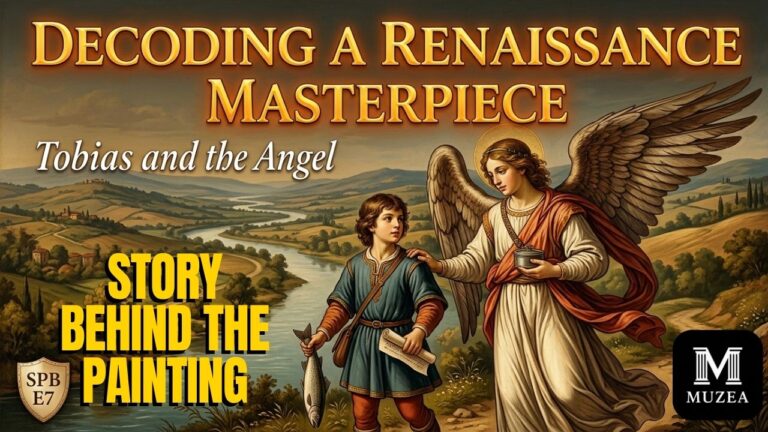
The latest episode of Story Behind the Painting by MUZEA takes us deep into a masterpiece that served as the “visual mascot” for these nervous fathers and ambitious sons: Tobias and the Angel (c. 1469), painted by the legendary brothers Antonio and Piero del Pollaiuolo.

More Than a Bible Story

At first glance, the painting depicts a scene from the Book of Tobit. Young Tobias is sent by his blind father to collect a debt in a distant city. But as the episode reveals, the Pollaiuolo brothers weren’t just retelling scripture; they were painting the lived reality of the Florentine elite [00:19].

Tobias represents the next generation of the merchant class. In his hand, he carries a small roll of parchment. In the 1400s, this wasn’t just a letter—it was a bill of exchange [01:23]. This “high-tech” financial tool allowed bankers to move vast sums of money across borders without carrying heavy, target-painting bags of gold. It was the Renaissance equivalent of a wire transfer.

The Ultimate Mentor: Archangel Raphael

The journey was dangerous, which is why Tobias isn’t alone. He is accompanied by the Archangel Raphael, often called the “Angel of Safe Conduct” [01:49].

The episode highlights a fascinating detail: the striking similarity between the faces of Tobias and the Angel. This suggests a “guardian twin” concept—the idea that every person has a heavenly double guiding them. Raphael is the ultimate mentor, the “heavenly double” of the young apprentice, providing divine protection as the boy navigates the “mission of trust” [02:19].

The Symbolism of the Fish and the Dog

Two animals play crucial roles in this composition:

  1. The Fish: Tobias carries a fish caught from the Tigris River [02:56]. While it literally refers to the source of the medicine needed to cure his father’s blindness, it also acts as a “code.” In mercantile culture, it was a symbol of validity, and spiritually, it represented Christ (via the Greek acrostic ichthus).

  2. The Dog: A small, fluffy dog trots ahead of the pair. In art history, the dog is the universal symbol of fidelity and loyalty [04:51]—essential traits for a young man trusted with the family’s wealth and reputation.

The “Power Duo” Behind the Canvas

The episode dives into the fascinating history of the artists, Antonio and Piero del Pollaiuolo. Interestingly, “Pollaiuolo” wasn’t their real last name; it was a nickname derived from their father’s job as a poultry seller (pollo meaning hen coop in Italian) [06:27].

While their father dealt in chickens, the brothers had much loftier ambitions. They became the “Silicon Valley” of their day, experimenting with revolutionary techniques:

  • The Oil Revolution: At a time when most Italian artists used flat, matte egg tempera, the Pollaiuolos were among the first to use translucent oil glazes [05:48]. This is why the fabrics in the painting—the crimson jackets, velvet, and silk—shimmer with such realistic depth.

  • Anatomical Outlaws: Legend has it the brothers were the first to perform human dissections [07:41]. They didn’t want to just paint a figure; they wanted to show the tension of skin over flexing muscle, a pursuit that would later influence Michelangelo.

  • The Cinematic Landscape: The background shows the Arno Valley with a high vantage point, giving the painting a “cinematic drone shot feel” that was revolutionary for the 1460s [08:20].

Why It Matters Today

The beauty of Tobias and the Angel lies in its humanity. As the narrator aptly puts it, the painting represents the universal bridge between childhood and adult responsibility [09:56].

Whether it’s a Florentine teenager in 1469 clutching a bill of exchange or a modern graduate heading to their first internship, the feeling remains the same: a mix of fear, excitement, and the search for a mentor to show the way. The Pollaiuolo brothers didn’t just paint a religious scene; they captured the weight of expectations and the hope of a safe return.


Watch the full breakdown here:


If you stumbled across the right panel of the Melun Diptych without context, you might assume it was a modern CGI render, a surrealist fever dream from the 1920s, or perhaps a high-fashion editorial. The Virgin Mary is startlingly pale, her hairline is plucked back to another zip code, and she sports a perfectly spherical, exposed breast.

But this isn’t modern art. It was painted in 1452 by Jean Fouquet, and it remains one of the most provocative, unhinged, and “messy” devotional paintings in history.


The Power Player: Etienne Chevalier

To understand this painting, we first have to meet the man who paid for it: Etienne Chevalier. In the 1450s, Etienne was the “CFO of France”—the royal treasurer for King Charles VII. A self-made man who rose through the ranks, he was described as incorruptible, trustworthy, and so close to the king that he was the executor of the royal will [03:00].

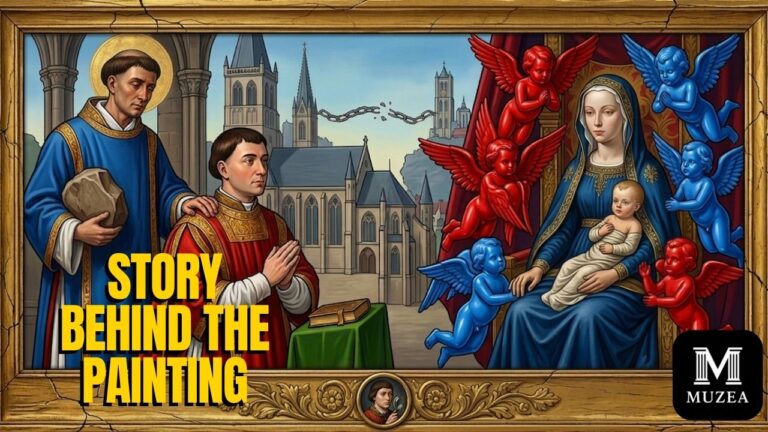
Etienne commissioned this diptych to hang over his wife’s tomb in the Church of Notre-Dame in Melun. In the left panel, we see Etienne himself in a permanent state of prayer. Standing behind him is his namesake, St. Stephen (Etienne in French).

St. Stephen is dressed as a deacon in stunning blue robes, but he’s carrying a gruesome “signature accessory”: a jagged, bloodstained stone resting on a book [03:25]. As the first Christian martyr, Stephen was stoned to death, and in medieval art, saints always carry the instruments of their demise like a grim fashion statement.

The Scandalous Madonna: Agnès Sorel

The right panel is where things get “spicy.” While the diptych was meant to honor Etienne’s late wife, the Virgin Mary looks nothing like her.

Art historians have long held an “open secret”: the model for the Virgin is believed to be Agnès Sorel, the “Lady of Beauty” and the official mistress of King Charles VII [04:13]. Etienne wasn’t just the king’s treasurer; he was one of Agnès’s closest friends.

By commissioning a painting where the king’s mistress is depicted as the Mother of God, Etienne was pulling off the ultimate 15th-century “flex.” He was signaling his proximity to power, his grief for a lost friend, and his hope for a VIP pass to heaven by knowing the right people. It’s a bizarre mix of humble devotion and high-society blasphemy [05:01].

The Artist from the Future: Jean Fouquet

If the Melun Diptych feels like it’s from another dimension, it’s because Jean Fouquet was an artist ahead of his time. Around 1446, Fouquet did a “study abroad” trip to Italy [05:37]. He was one of the few French painters of his era to study Italian linear perspective and 3D volume, even painting a portrait of Pope Eugenius IV while in Rome.

Fouquet was also a master miniaturist, accustomed to looking at the world through a magnifying glass. He used a technique involving melted glass (enamel) to give his work a high-gloss, high-definition finish that looks like a 4K screen [06:14].

The result is the Uncanny Valley. Look at the angels surrounding Mary: they aren’t soft or fluffy. They are monochromatic, bright red cherubim and blue seraphim that look like polished plastic figurines [07:08]. Fouquet used geometry and lighting in a robotic, supernatural way to create a high-fashion atmosphere that felt more like a “liminal space” than a traditional church.

A Long-Distance Tragedy

Today, the Melun Diptych is a victim of a “historical divorce.” During the French Revolution, the two halves were ripped apart. The left panel (the “boys”) now lives in Berlin, while the right panel (the “queen”) lives in Antwerp [07:48].

Scientists used dendrochronology (tree-ring dating) to prove the two panels are “soulmates”—both were cut from the exact same oak tree felled in 1446 [07:59]. Though they belong together, they haven’t shared a room in centuries.

The World’s First Selfie

Fouquet knew he was the “GOAT” (Greatest of All Time). He didn’t just paint the diptych; he signed it with a tiny enamel medallion of himself [08:18]. This is considered the oldest signed self-portrait in Western art history. He wanted the world to remember the name: Johes Fouquet.

The Melun Diptych serves as a reminder that people in the 1400s were just as obsessed with status, celebrity, and “aesthetic” as we are today. Next time you think your social media feed is too curated, just remember that Etienne Chevalier spent his life savings to be remembered forever standing next to the king’s mistress in a blue-and-red fever dream.


Stay curious. Stay messy.

Watch the full episode on MUZEA:

When we think of St. Nicholas today, the image that usually springs to mind is a jolly, white-bearded man in a red suit delivering toys in the dead of winter. But in the 15th century, “Santa Claus” looked quite different. He was a powerful, miracle-working fixer, a patron of merchants, and a spiritual “crisis manager.”

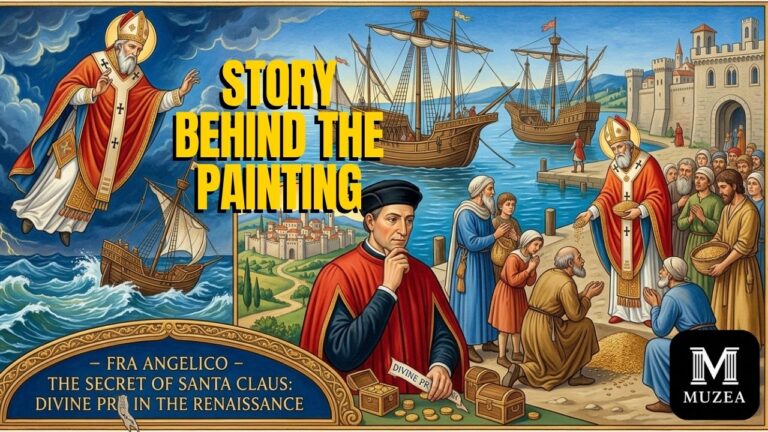
In the latest episode of Story Behind the Painting, we explore Fra Angelico’s 1437 masterpiece, St. Nicholas Saves the Ship. This work doesn’t just show us a saint; it reveals the complex intersection of faith, finance, and early Renaissance “influencer culture.”


From Bishop of Myra to Global Icon

Before he was a pop-culture legend, St. Nicholas was a 4th-century bishop in Myra (modern-day Turkey) [02:03]. While the “Golden Legend”—the medieval collection of saintly lives—is full of embellishments, the historical core of Nicholas is real.

The gift-giving tradition we associate with Christmas began with a story of Nicholas secretly providing bags of gold to a poor man to save his daughters from a life of destitution [02:35]. As the episode explains, this figure eventually evolved into Sinterklaas in the Netherlands and was brought to the New World by Dutch settlers, eventually merging into the modern Santa Claus we know today [02:42].

The Miracle of the Grain Ship

Fra Angelico’s painting, commissioned as a predella panel for an altarpiece in Perugia, depicts a different side of the saint [03:37]. Instead of toys, Nicholas is dealing with a grain ship during a famine.

The painting uses a technique called continuous narrative [03:53]. In a single frame, we see multiple moments of time:

  • A dramatic storm where the saint intervenes to save the vessel.

  • The calm harbor where the grain is safely distributed to a starving population.

By merging these moments, Fra Angelico highlights Nicholas’s role as a protector of the vulnerable—specifically sailors, merchants, and bankers who faced the treacherous risks of the 15th-century economy [01:22].

The “Selfie” of the 1400s: Cosimo de’ Medici

Perhaps the most intriguing detail in the painting is the presence of a figure in a prominent red cloak and black cap. Art historians believe this is none other than Cosimo de’ Medici, the de facto ruler of Florence and the head of the most powerful bank in Europe [04:40].

Why is a billionaire banker standing in a scene from the 4th century?

The episode draws a sharp modern parallel: it’s like a modern-day influencer filming themselves giving money to the poor to boost their image [05:02]. This was “Divine PR.” By placing himself next to St. Nicholas, Cosimo was linking his family’s immense wealth to divine favor. It served as a public statement to legitimize his financial practices and signal his piety to the masses [05:11].

A Touch of the Surreal

While Fra Angelico is known for his luminous colors and profound spirituality, the episode notes that this painting has a surprisingly “surreal” quality [06:11]. Because it presents multiple timelines and scales in one space—with realistic ships alongside a fantastical sea monster and an ethereal hovering saint—it evokes a dreamlike quality that predates the surrealist movement by centuries [06:20].

Fra Angelico was a Dominican friar who bridged the gap between the late Gothic style and the emerging Renaissance [05:51]. In this panel, he managed to capture both the mystical power of faith and the very grounded, political realities of his patrons.

Conclusion

St. Nicholas’s journey from a Turkish bishop to a Dutch folk hero to a global commercial icon is one of history’s most fascinating cultural evolutions. Fra Angelico’s St. Nicholas Saves the Ship reminds us that before the reindeer and the chimney, he was the saint you called when your ship was sinking—literally and financially.


Want to dive deeper into the world of art? Download the MUZEA app on the App Store or Google Play to explore more stories behind the world’s most famous paintings.

Watch the full episode here:

In the modern world, we “flex” our success through designer clothes, high-end smartphones, or luxury travel. In the 15th century, however, the ultimate status symbol wasn’t a car—it was a commissioned painting. But as the latest episode of Story Behind the Painting reveals, the Mérode Altarpiece (or the Annunciation Triptych) by Robert Campin was more than just a display of wealth; it was a complex blend of marketing, domestic prayer, and revolutionary artistic detail.

The Ultimate Textile Flex

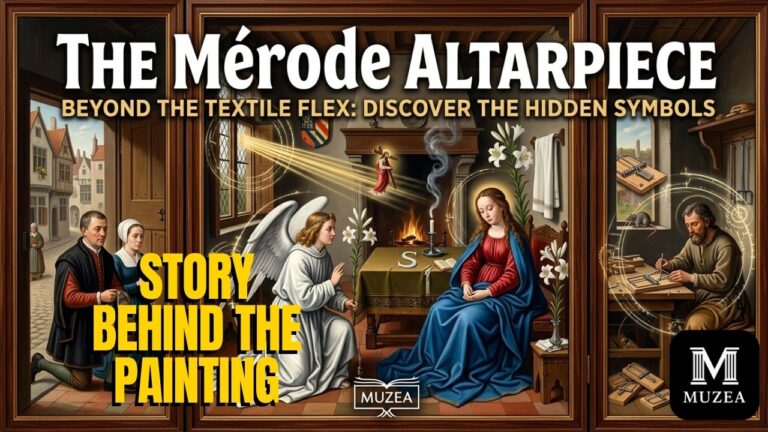
Unlike most grand altarpieces of the era, this work wasn’t commissioned by a priest for a cathedral. Instead, it was paid for by a wealthy merchant, likely from the Inghelbrecht family (identified by the coat of arms in the window) [01:39].

Because the client made his fortune in textiles, the painting is essentially a high-end advertisement for his business. Look closely at the robes of the Angel Gabriel and the Virgin Mary—the fabric is heavy, voluminous, and folded with such precision that it dominates the frame. By showcasing such “finesse” in the rendering of cloth, the merchant was subtly promoting the quality of his own wares [01:20].

A Home for the Holy

The Mérode Altarpiece was designed as a home altar. Measuring roughly two feet tall, it was intended for private devotion in a middle-class Dutch home [01:54]. The owners would kneel before it to pray to Mary, often asking for the blessing of children.

What makes this painting a masterpiece of the Northern Renaissance is its setting. While Italian artists were obsessed with the idealized human body and mathematical perspective, Northern artists like Campin focused on hyper-realistic textures and domestic interiors. Through the use of oil paint, Campin captured:

  • The rust on iron nails [03:30].

  • The delicate feathers of an angel’s wings.

  • Double shadows cast on the walls, suggesting two light sources—the window and the open door—a level of “ray tracing” that was centuries ahead of its time [05:41].

Hidden Symbols in Every Corner

The central panel depicts the Annunciation—the moment Gabriel tells Mary she will bear the Son of God. But Campin strips away the traditional golden halos to make the figures feel more human and accessible [05:07]. Instead, holiness is signaled through everyday objects:

  • The Tiny Jesus: Look for a small figure carrying a cross flying through the window on seven beams of light [05:25].

  • Purity Symbols: The white lilies, the clean white towel, and the polished water pot all represent Mary’s virginity.

  • The Extinguished Candle: A thin wisp of smoke rises from a candle that was just blown out. Some suggest this represents the moment the Divine enters the physical world, 혹은 perhaps a draft from the open door [06:08].

Joseph and the Mouse Traps

The right panel features Joseph in his workshop, and it contains one of the most famous “Easter eggs” in art history: mouse traps [06:54]. One sits on his workbench, and another is displayed on the window ledge outside.

While some theologians argue the trap symbolizes Christ as the “bait” to catch the devil, there’s a more practical theory related to the time. The 15th century was still reeling from the Black Plague, which people knew was carried by rats. By showing Joseph making mouse traps, the painting portrays him as a provider and a protector—keeping the home safe from both physical disease and spiritual evil [07:37].

The World Outside the Window

While the interior feels peaceful, the world outside was anything but. The 15th century was defined by the Hundred Years’ War, English occupations, and civil unrest in cities like Paris and Ghent [02:46]. This painting offers a rare, idealized glimpse of peaceful Dutch streets, contrasting the chaos of the era with the eternal calm of the divine [02:39].

A Modern Twist

The episode concludes with a playful “updated” version of the triptych created by AI. In this modern reimagining, the holy family lives in a cramped apartment (due to the housing crisis), Joseph is a software engineer protecting the home from cyber attacks, and the angel Gabriel might have a hard time fitting through the small windows [09:46]!

Whether viewed in the 1400s or through a digital lens today, the Mérode Altarpiece remains a testament to the power of detail and the enduring intersection of the sacred and the mundane.


Watch the full analysis here:

Verified by MonsterInsights