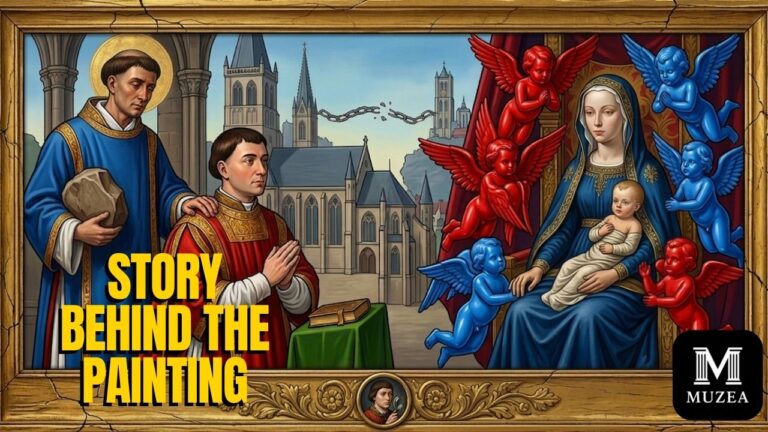
If you stumbled across the right panel of the Melun Diptych without context, you might assume it was a modern CGI render, a surrealist fever dream from the 1920s, or perhaps a high-fashion editorial. The Virgin Mary is startlingly pale, her hairline is plucked back to another zip code, and she sports a perfectly spherical, exposed breast.
But this isn’t modern art. It was painted in 1452 by Jean Fouquet, and it remains one of the most provocative, unhinged, and “messy” devotional paintings in history.
The Power Player: Etienne Chevalier
To understand this painting, we first have to meet the man who paid for it: Etienne Chevalier. In the 1450s, Etienne was the “CFO of France”—the royal treasurer for King Charles VII. A self-made man who rose through the ranks, he was described as incorruptible, trustworthy, and so close to the king that he was the executor of the royal will [03:00].
Etienne commissioned this diptych to hang over his wife’s tomb in the Church of Notre-Dame in Melun. In the left panel, we see Etienne himself in a permanent state of prayer. Standing behind him is his namesake, St. Stephen (Etienne in French).
St. Stephen is dressed as a deacon in stunning blue robes, but he’s carrying a gruesome “signature accessory”: a jagged, bloodstained stone resting on a book [03:25]. As the first Christian martyr, Stephen was stoned to death, and in medieval art, saints always carry the instruments of their demise like a grim fashion statement.
The Scandalous Madonna: Agnès Sorel
The right panel is where things get “spicy.” While the diptych was meant to honor Etienne’s late wife, the Virgin Mary looks nothing like her.
Art historians have long held an “open secret”: the model for the Virgin is believed to be Agnès Sorel, the “Lady of Beauty” and the official mistress of King Charles VII [04:13]. Etienne wasn’t just the king’s treasurer; he was one of Agnès’s closest friends.
By commissioning a painting where the king’s mistress is depicted as the Mother of God, Etienne was pulling off the ultimate 15th-century “flex.” He was signaling his proximity to power, his grief for a lost friend, and his hope for a VIP pass to heaven by knowing the right people. It’s a bizarre mix of humble devotion and high-society blasphemy [05:01].
The Artist from the Future: Jean Fouquet
If the Melun Diptych feels like it’s from another dimension, it’s because Jean Fouquet was an artist ahead of his time. Around 1446, Fouquet did a “study abroad” trip to Italy [05:37]. He was one of the few French painters of his era to study Italian linear perspective and 3D volume, even painting a portrait of Pope Eugenius IV while in Rome.
Fouquet was also a master miniaturist, accustomed to looking at the world through a magnifying glass. He used a technique involving melted glass (enamel) to give his work a high-gloss, high-definition finish that looks like a 4K screen [06:14].
The result is the Uncanny Valley. Look at the angels surrounding Mary: they aren’t soft or fluffy. They are monochromatic, bright red cherubim and blue seraphim that look like polished plastic figurines [07:08]. Fouquet used geometry and lighting in a robotic, supernatural way to create a high-fashion atmosphere that felt more like a “liminal space” than a traditional church.
A Long-Distance Tragedy
Today, the Melun Diptych is a victim of a “historical divorce.” During the French Revolution, the two halves were ripped apart. The left panel (the “boys”) now lives in Berlin, while the right panel (the “queen”) lives in Antwerp [07:48].
Scientists used dendrochronology (tree-ring dating) to prove the two panels are “soulmates”—both were cut from the exact same oak tree felled in 1446 [07:59]. Though they belong together, they haven’t shared a room in centuries.
The World’s First Selfie
Fouquet knew he was the “GOAT” (Greatest of All Time). He didn’t just paint the diptych; he signed it with a tiny enamel medallion of himself [08:18]. This is considered the oldest signed self-portrait in Western art history. He wanted the world to remember the name: Johes Fouquet.
The Melun Diptych serves as a reminder that people in the 1400s were just as obsessed with status, celebrity, and “aesthetic” as we are today. Next time you think your social media feed is too curated, just remember that Etienne Chevalier spent his life savings to be remembered forever standing next to the king’s mistress in a blue-and-red fever dream.
Stay curious. Stay messy.
Watch the full episode on MUZEA: